HDPE Cutting Board Guide - Sanitization, Resurfacing & Safety
📑 Table of Contents
The HDPE Master Guide: Why HDPE Became the Kitchen Standard
Section titled “The HDPE Master Guide: Why HDPE Became the Kitchen Standard”High-Density Polyethylene (HDPE), Resin Identification Code #2, is the dominant plastic used for commercial cutting boards because it is tough, hydrophobic, and chemically resistant. In institutional kitchens, HDPE boards are favored because they do not soak up raw meat juices the way unsealed wood can.
HDPE is a semi-crystalline thermoplastic with very low water absorption (often cited below 0.01% by mass under typical conditions). That low uptake reduces liquid penetration, but it does not eliminate microbial risk after the surface is mechanically damaged.
HDPE also sits in a useful mechanical window for knives. It is hard enough (commonly Shore D ~60 to 70) to avoid immediate gouging, while still yielding at the edge so it is far less destructive to knives than glass, stone, or ceramic.
The safety tradeoff is that HDPE is only truly easy to clean when it is smooth. Once scarred, plastic can support biofilm formation inside knife tracks, a key point supported by classic cutting board cross-contamination work by Dean Cliver and others.
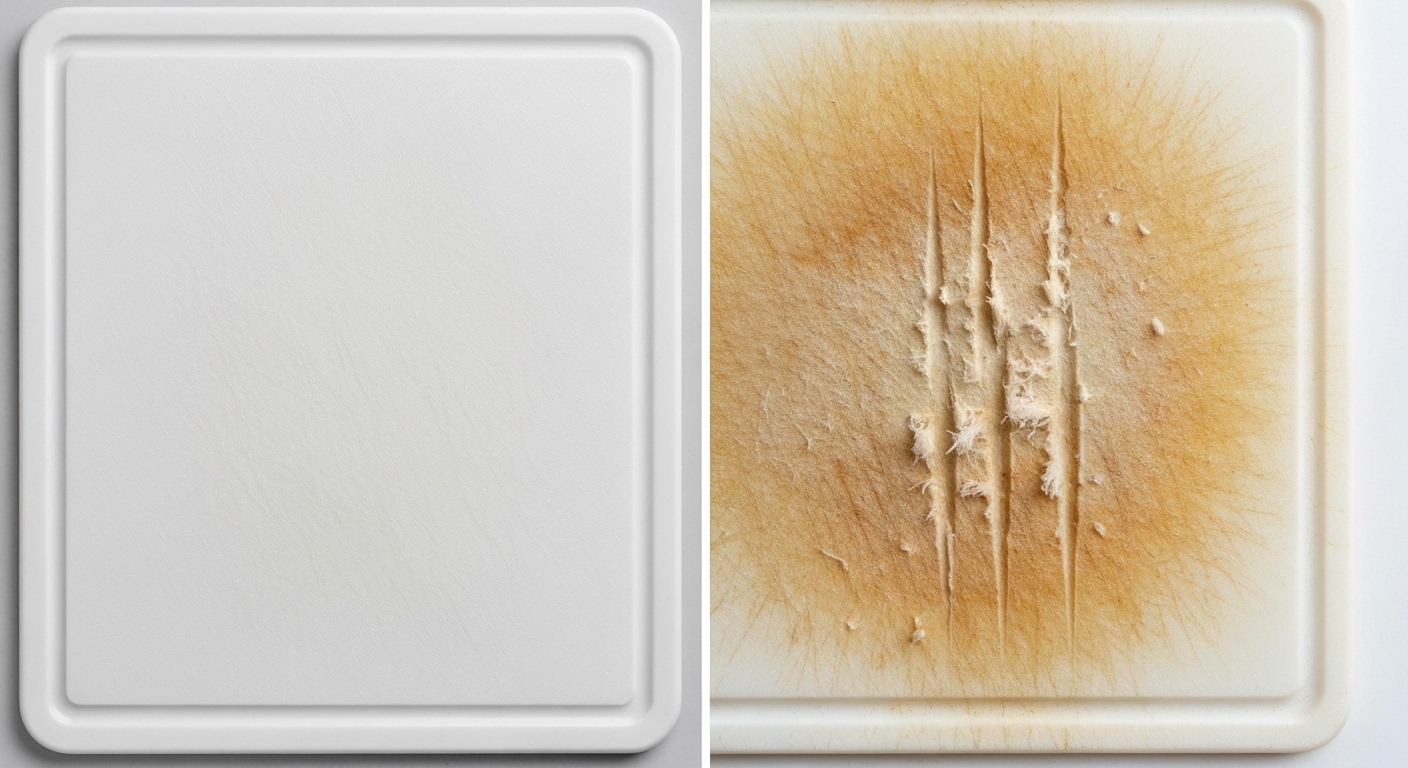
HDPE Board Maintenance Lifecycle (New, Daily Use, Resurface, Retire)
Section titled “HDPE Board Maintenance Lifecycle (New, Daily Use, Resurface, Retire)”A practical way to keep an HDPE board safe is to treat it like a surface with a lifecycle, not a forever tool. The goal is to keep the board smooth enough to clean, then remove the damaged layer when scratches accumulate, and retire it when structural or hygienic defects can no longer be corrected.
Stage 1, new board setup: Label or dedicate boards by food type (especially raw poultry). Add non-slip control (a damp towel under the board) so you do not develop heavy sawing technique that accelerates wear and shedding.
Stage 2, daily routine: Wash promptly with hot water and dish detergent, scrub into cuts with a stiff brush, then air dry vertically. Use chemical sanitization after high-risk foods (raw poultry, ground meat, seafood) or when the board was left wet and warm.
Stage 3, resurfacing interval: When the board feels fuzzy, looks matte-white, or shows dense overlapping knife tracks, remove the damaged surface layer by scraping or sanding. Resurfacing restores cleanability and typically reduces microplastic release compared with continuing to cut on a fibrillated surface.
Stage 4, retirement: Replace the board if deep grooves remain after resurfacing, if it is pitted from heat or chemical attack, or if warping creates instability that increases knife injury risk. When a board has lost flatness or has deep defect geometry, sanitizers cannot reliably reach all surfaces at sufficient concentration and contact time.
How to Sanitize an HDPE Cutting Board (USDA Method)
Section titled “How to Sanitize an HDPE Cutting Board (USDA Method)”- Wash first: Scrub with hot soapy water, then rinse. Chlorine is rapidly consumed by proteins and fats, so sanitizing a dirty board is chemically inefficient.
- Sanitize: Use 1 tablespoon (15 mL) of unscented liquid chlorine bleach per 1 gallon (3.8 L) of water, apply to fully wet the surface.
- Contact time: Keep the surface wet for 2 minutes.
- Rinse and dry: Rinse with clean water, then air dry vertically or on edge.
Sanitizer Chemistry: Bleach Ratios, Peroxide, and Quats (What Is Compatible With HDPE)
Section titled “Sanitizer Chemistry: Bleach Ratios, Peroxide, and Quats (What Is Compatible With HDPE)”Household chlorine bleach (sodium hypochlorite) is effective for non-porous food-contact surfaces when used at the right dilution and with adequate contact time. Over-bleaching is not safer, it increases respiratory irritation, can discolor surfaces, and can accelerate long-term oxidation of plastics at the surface.
Hydrogen peroxide is an alternative oxidizer and is generally compatible with HDPE at typical household concentrations. It can be useful when chlorine odor is unacceptable, but it is not a universal substitute because efficacy depends strongly on concentration, wet contact time, and the organism.
Quaternary ammonium compounds (quats) are widely used in commercial food service on plastics because they provide residual antimicrobial activity on hard surfaces. They can leave residues if not used per label directions, so they are best reserved for users who can follow a tested food-contact protocol and rinse requirements.
Do not mix sanitizers, particularly bleach with acids (vinegar, citric acid) or ammonia, because toxic gases can form. For home users, the simplest high-reliability approach is detergent wash, then properly diluted bleach, then rinse and dry.
Microplastic Shedding From HDPE Cutting Boards (What We Know, What We Do Not)
Section titled “Microplastic Shedding From HDPE Cutting Boards (What We Know, What We Do Not)”Cutting on any polymer board is a micro-machining process. Knife edges impose localized shear and compressive forces that can detach polymer fragments, especially when the surface has fibrils, flaps, or raised lips around cuts.
A frequently cited 2023 estimate suggested high-end exposure could approach tens of grams per year for heavy home use, but the uncertainty is large because results depend on knife type, cutting technique, board hardness, food moisture, and how much debris is captured and ingested versus washed away. A realistic interpretation is that the exposure distribution is wide, and the upper bound likely represents intensive use with high abrasion conditions.
HDPE is chemically simple (a saturated carbon and hydrogen backbone) and does not require plasticizers. It contains no BPA and is generally regarded as one of the more inert commodity polymers, but inert chemistry does not automatically mean negligible biological impact at the particle scale.
Context matters because cutting boards are not the only household microplastic source. Indoor dust, synthetic textiles during laundering, and wear of plastic packaging all contribute particles, so a cutting board is best treated as one controllable contributor rather than the only exposure vector.
Risk reduction is mechanical and behavioral. A smoother board sheds less, straight push cuts generally abrade less than aggressive sawing, and timely resurfacing removes the damaged layer that both traps microbes and releases debris.
Resurfacing HDPE: Scraping vs Sanding (And Why Heat Guns Usually Make It Worse)
Section titled “Resurfacing HDPE: Scraping vs Sanding (And Why Heat Guns Usually Make It Worse)”Resurfacing works because most of the hygiene problem lives in the top fraction of a millimeter where the highest cut density occurs. If you remove that damaged layer, you restore a smoother, more cleanable surface with fewer crevices.
Commercial kitchens often use a board scraper that functions like a cabinet scraper or small plane, shaving off continuous ribbons of polyethylene. This is fast and produces less airborne dust than sanding, but it requires a stable grip and even pressure to keep the board flat.
At home, a random orbital sander can work if you control dust and finish correctly. A common progression is 80 grit to cut damage, 120 grit to level, and 220 grit to refine, but the end point should be functional smoothness rather than a glossy surface that becomes slippery.
After sanding, remove statically held dust with a stiff brush and hot soapy water, then rinse thoroughly. The dust you see and the dust you do not see are both microplastics, so do not skip this wash step.
Heat guns are often suggested to “melt scratches shut,” but spot heating HDPE promotes warping due to thermal expansion and relaxation of the semi-crystalline structure. You may cosmetically reduce a groove while degrading flatness, and flatness is a safety property because an unstable board increases knife slip incidents.
For detailed restoration workflows and tool-by-tool guidance, keep this article as your material safety reference and use the dedicated restoration guide: /kitchen/restoring-scratched-plastic-cutting-boards.
Dishwasher Safety, Warping Mechanics, and Safer Storage
Section titled “Dishwasher Safety, Warping Mechanics, and Safer Storage”Thick commercial boards (around 1 inch, 2.5 cm) tolerate dishwashers better because bending stiffness scales strongly with thickness. Thin consumer boards can warp when heated and mechanically constrained, then cooled in a bent geometry, which is polymer creep and stress relaxation expressed as the “potato chip” shape.
Warping is not just cosmetic. A board that rocks or spins can move under the knife, which is a leading cause of kitchen lacerations.
If you store a large thin HDPE board leaning at an angle, gravity can also drive slow creep over time. Store boards flat or vertical in a rack, and keep them away from continuous heat sources such as oven side panels or dishwasher exhaust.
Cross-Contamination Control: Color Coding Works
Section titled “Cross-Contamination Control: Color Coding Works”HACCP-style color coding is valuable because it reduces reliance on perfect sanitization every time. If raw poultry always stays on one board, an occasional sanitizing error is less likely to be transferred to ready-to-eat foods, especially when combined with good board maintenance practices like restoring scratched plastic cutting boards to limit places where bacteria can hide.
Common schemes are red for raw meat, yellow for poultry, blue for seafood, and green for produce. The specific colors matter less than consistent separation and an unambiguous habit.
Odors, Stains, and What They Really Mean
Section titled “Odors, Stains, and What They Really Mean”HDPE can retain odors because hydrophobic odor compounds partition into the near-surface polymer phase. Garlic sulfur compounds and fish amines are common offenders, and they are more persistent when the board has high surface area from scratches.
Acid and abrasion help because they remove the contaminated surface boundary layer and neutralize some odor chemistry. A lemon and coarse salt scrub provides both mild acid and mechanical removal, while a vinegar soak can reduce fishy amines by acid-base chemistry.
Stains from turmeric, beets, and carrots are often cosmetic dyes that prefer oily environments and can adsorb into the surface. They do not automatically indicate unsafe conditions, but heavy staining can make inspection harder, which is a practical reason to resurface or replace.
Safety: When to Retire an HDPE Board (Including Pitting)
Section titled “Safety: When to Retire an HDPE Board (Including Pitting)”Replace an HDPE board when defects exceed what cleaning chemistry and resurfacing can correct. The key failure modes are geometry you cannot reach, instability you cannot control, and polymer damage that indicates loss of mechanical integrity.
Pitting is a high-priority retirement signal. Pits are often caused by heat damage (hot pans) or harsh chemical exposure, and they create pooled, hard-to-drain micro-environments with more surface area than linear scratches.
Deep grooves that catch a fingernail are another retirement signal if resurfacing cannot remove them. A sponge rides over a trench, and even a brush can fail to generate enough shear at the bottom of a deep cut to remove biofilm reliably.
If the board is warped and cannot be reliably flattened, retire it. Instability is a direct injury hazard, and a board that does not sit flat is difficult to sanitize consistently.
HDPE vs Wood vs HDPP (And the Myth That Plastic Is Always Safer)
Section titled “HDPE vs Wood vs HDPP (And the Myth That Plastic Is Always Safer)”The common myth is that plastic is automatically safer because it is non-porous. The evidence is more nuanced: a smooth plastic surface can be easy to sanitize, but a heavily scarred plastic surface can hold bacteria in protected niches, while some wood species can reduce bacterial survival through drying dynamics and natural extractives.
Use the decision factors that actually control risk: surface damage, cleanability, drying rate, and whether you can maintain the board. A well-maintained wood board and a well-maintained HDPE board can both be safe, but both can become unsafe when neglected.
| Board material | Hygiene behavior under damage | Heat tolerance | Maintenance profile | Microplastic concern |
|---|---|---|---|---|
| HDPE (#2) | Becomes harder to sanitize as scratches and fuzz accumulate | Moderate, thin boards often warp in dishwasher | Low daily effort, periodic resurfacing needed | Yes, polymer fragments from abrasion |
| HDPP (high-density polypropylene) | Typically better scratch resistance than HDPE, still needs resurfacing | Higher softening range than HDPE in practice | Similar to HDPE, often longer resurfacing interval | Yes, still an abrading polymer |
| Wood (end-grain hardwood) | Can reduce bacterial survival through drying and capillary effects, but not sterilizing | High, but can crack with soaking and dishwashers | Requires oiling and controlled washing, no bleach | No polymer fragments, but can shed wood fibers |
Bamboo and wood composites often rank in searches because they look clean and are marketed as antimicrobial. Bamboo is a grass with high silica content, which can be harder on knives, and laminated bamboo relies on adhesives that do not behave like solid hardwood under repeated wetting and drying.
Composite boards vary widely. Some embed wood fibers in resin, which reduces swelling but can behave more like a hard plastic in knife wear, and the sanitizing guidance depends on the binder polymer.
HDPE vs Other Plastic Cutting Boards (PP, HDPP, TPU)
Section titled “HDPE vs Other Plastic Cutting Boards (PP, HDPP, TPU)”Not all “plastic cutting boards” behave the same because polymer crystallinity, hardness, and heat deflection control scratching and warping; since marketing terms are inconsistent, it helps to identify household plastics and recycling codes so you can focus on the polymer family and the board thickness.
HDPE is tough and forgiving, but it can develop surface fibrillation under repeated slicing. Standard polypropylene (PP) is often slightly stiffer and can show improved heat performance in dishwashers, and high-density polypropylene (HDPP) boards are commonly chosen in commercial settings for better scratch resistance and higher practical heat tolerance.
TPU (thermoplastic polyurethane) is sometimes used for flexible mats. TPU can feel grippy and quiet under the knife, but it is generally softer, can show faster cut-through and gouging, and some formulations are more sensitive to high heat or aggressive oxidizers than HDPE.
If your priority is a longer interval between resurfacings and better dishwasher resilience, a thick HDPP board is often the most practical upgrade. If your priority is easy lifting and storage, a thin HDPE mat may be convenient, but it should be treated as a faster-wearing consumable.
Environmental Impact of Plastic Cutting Boards (HDPE #2 Reality)
Section titled “Environmental Impact of Plastic Cutting Boards (HDPE #2 Reality)”From a lifecycle perspective, the biggest environmental lever is service life. A board you replace every few months generates more polymer demand and waste than a thicker board you resurface and keep for years.
HDPE is Resin Code #2 and is widely accepted in many recycling programs, but real-world recycling depends on local sorting and contamination rules. A heavily scarred cutting board may be rejected by municipal programs due to food contamination, thickness, or non-bottle form factors, so the practical outcome is often landfill unless you have access to specialty plastics recycling.
Microplastics are also an environmental tradeoff. Polymer fragments generated during use can enter wastewater and solid waste streams, while wood boards can shed biodegradable fibers but can drive different resource impacts through forestry, adhesives (for bamboo), and maintenance oils.
For disposal, check your local recycler’s acceptance rules for rigid HDPE items. If recycling is not available, extending usable life through resurfacing and retiring only when necessary is typically the most realistic waste-reduction strategy for plastic boards.
FAQ: HDPE Cutting Board Safety
Section titled “FAQ: HDPE Cutting Board Safety”What is the correct bleach ratio for sanitizing an HDPE cutting board? 1 tablespoon (15 mL) of unscented liquid bleach per 1 gallon (3.8 L) of water, keep the surface wet for 2 minutes, then rinse and air dry.
Can an HDPE cutting board go in the dishwasher? Thick commercial boards are often dishwasher safe, but thin boards commonly warp due to heat and mechanical constraint. If warping creates rocking or spinning, stop dishwashing that board and replace it if flatness cannot be restored.
Are microplastics from HDPE cutting boards a real concern? HDPE can shed fragments during cutting, and estimates vary widely based on usage and technique. Keeping the surface smooth, avoiding aggressive sawing cuts, and resurfacing when fuzzy are the most effective controls.
When should I replace my HDPE cutting board? Replace it if it is pitted, deeply grooved after resurfacing attempts, permanently warped and unstable, or shows oxidized brittle edges and persistent black discoloration that suggests embedded contamination.
References
Section titled “References”- Cliver, D. O. Cutting boards and cross-contamination studies (UC Davis and related peer-reviewed literature).
- Snyder, O. P. The Microbiology of Cleaning and Sanitizing a Cutting Board, Hospitality Institute of Technology and Management.
- FDA Food Code, 4-101.11 Characteristics of Food Contact Surfaces.
- Selected 2023 microplastic abrasion estimates for kitchen cutting boards, noting high variance by method and assumptions.