Polycarbonate Lens Scratch Repair - The Truth About Coatings
📑 Table of Contents
Prescription eyewear “scratches” are usually coating damage, not gouges in the lens plastic. That distinction controls what is fixable, what will get worse, and when replacement is the only safe choice.
This guide is scoped to prescription lenses and coated optical lenses. If you are working on non-optical, uncoated plastics (instrument windows, shields, hobby parts), see scratch for product-focused options and surface polishing strategies that are not appropriate for AR-coated eyewear.
Step 1: Identify Your Lens Type and Coatings at Home
Section titled “Step 1: Identify Your Lens Type and Coatings at Home”You do not need lab equipment to get a high-confidence read on lens material and coating stack. What you are really diagnosing is whether you are looking at a soft substrate (polycarbonate) protected by coatings, or a harder substrate (often CR-39) that still relies on coatings for real-world wear.
Home identification cues (polycarbonate vs CR-39 vs acrylic)
Section titled “Home identification cues (polycarbonate vs CR-39 vs acrylic)”Start with markings. Safety-rated polycarbonate often has an ANSI Z87 or Z87+ stamp on the lens or frame, and many sunglass lenses have an etched logo near the edge.
Use edge and tint cues next. Polycarbonate edges often show a faint gray or smoky cast and can look slightly “denser” than CR-39, while CR-39 often has a cleaner, water-clear edge.
Use weight as a sanity check. For similar lens size and thickness, polycarbonate tends to feel lighter than CR-39, while acrylic varies widely and is less common in prescription eyewear because it cracks more easily and can have inferior stress behavior.
Look for coating signatures under light. An anti-reflective (AR) stack frequently shows a purple, green, or blue residual reflection, and hydrophobic topcoats often reveal themselves when water beads tightly rather than sheeting.
Quick optical distortion check (helps separate “material” from “damage”)
Section titled “Quick optical distortion check (helps separate “material” from “damage”)”Hold the lens at arm’s length and look at a straight line (window frame edge) to assess distortion—useful context for understanding why toothpaste doesn’t really fix polycarbonate scratches. Move the lens slowly side to side.
If you see wavy distortion in otherwise “clear” areas, you are not looking at a simple scratch problem. That can indicate warpage, stress birefringence, or coating failure patterns that scatter light broadly.
Optical Plastic Physics: Polycarbonate vs. CR-39 (and where acrylic fits)
Section titled “Optical Plastic Physics: Polycarbonate vs. CR-39 (and where acrylic fits)”Modern eyeglass lenses are multilayer optical systems: the base polymer provides shape and refractive index, while coatings provide most of the abrasion resistance and much of the optical performance, which is why care and repair approaches differ—polishing acrylic watch crystals is different from glasses because removing or damaging lens coatings can quickly degrade vision.
A typical coated lens stack is base material (polycarbonate, CR-39, or high-index thiourethane), then a siloxane hard coat, then an AR metal-oxide stack, then a hydrophobic and oleophobic topcoat. When you “scratch” the lens, you usually damage the hard coat and topcoat, or you crack and delaminate the brittle AR layers.
| Property | Polycarbonate (PC) | CR-39 (ADC) | Acrylic (PMMA, less common for Rx) |
|---|---|---|---|
| Intrinsic hardness (uncoated) | Low, scratches easily | Moderate | Moderate, but brittle |
| Impact resistance | Excellent (safety standard choice) | Poor to fair, can fracture | Poor, prone to cracking |
| Optical clarity and chromatic aberration | More chromatic aberration than CR-39 | Better optical clarity than PC | Can be clear, but not ideal under stress |
| Reliance on hard coat | Very high, performance depends on coating integrity | High (still benefits greatly from coatings) | Variable |
| Common use cases | Children’s eyewear, safety glasses, sports | Standard “plastic” prescription lenses | Shields, displays, non-Rx windows |
The practical consequence is simple. If the coating is damaged, polishing attempts usually enlarge the damaged zone, and polycarbonate is the least forgiving substrate once exposed.
Step 2: Determine the Scratch Type (what you are actually seeing)
Section titled “Step 2: Determine the Scratch Type (what you are actually seeing)”There are three common failure modes that people describe as “scratches.” Each has a different repair reality.
A distinct line you can catch with a fingernail is typically a gouge through coatings and into the substrate, or a deep cut in the hard coat. A hazy patch or rainbowy sheen usually indicates micro-abrasion (thousands of fine swirls) in the topcoat and hard coat.
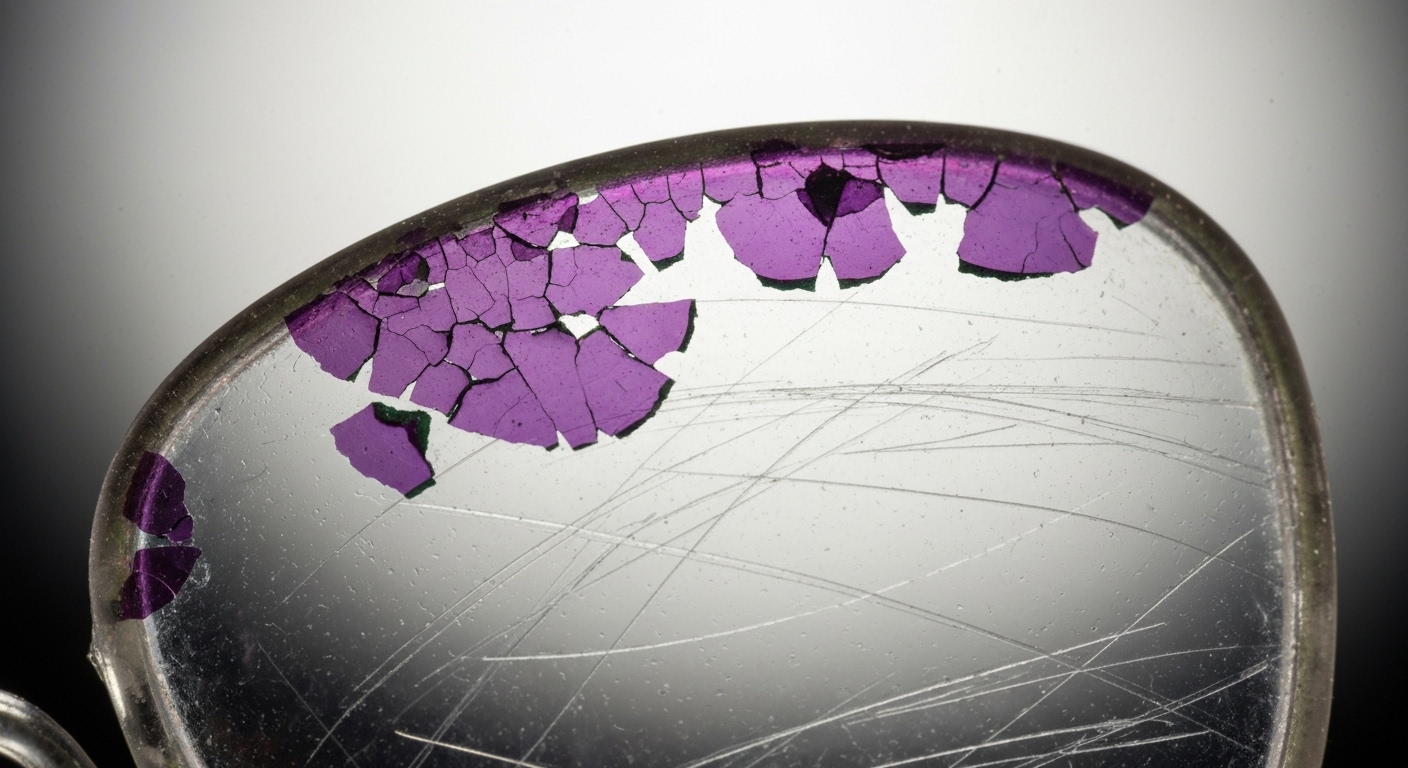
A crackled, foil-like network is crazing or brittle fracture of the AR stack, often triggered by heat, solvents, or stress. If you see crazing, you are dealing with coating failure, not dirt, and it is not polishable.
Step 3: Lens Scratch Decision Tree (repair vs replace)
Section titled “Step 3: Lens Scratch Decision Tree (repair vs replace)”Use this flow to decide what to do next. The goal is to avoid the common mistake of “trying something” that permanently clouds the optical zone.
- Is there AR coating (purple/green reflection) or hydrophobic beading? Yes, treat it as a coated lens and do not use abrasives or polishes. No, proceed cautiously.
- Does the defect look like crackled crazing or peeling (delamination)? Yes, replace lenses. No, continue.
- Does the defect disappear when wet (water film makes it vanish)? Yes, it is often a surface scuff in topcoat or residue, start with correct cleaning only. No, continue.
- Is the defect in the central viewing zone, or does it cause halos at night? Yes, replacement is usually the safest medical choice. No, continue.
- Is the lens non-prescription and uncoated (shield, window, cheap goggle)? Yes, controlled plastic polishing may help. No, avoid polishing and consider professional re-lensing.
What Can and Cannot Be Fixed on Prescription Lenses
Section titled “What Can and Cannot Be Fixed on Prescription Lenses”What you can do safely: cleaning and inspection
Section titled “What you can do safely: cleaning and inspection”Most “sudden scratches” are actually grease films plus dust dragging damage. Proper cleaning removes the film and prevents additional abrasion while you assess whether the coating is truly compromised.
Rinse with warm tap water first to remove grit, then wash with a small drop of dish soap using clean fingers, then rinse and blot dry with clean optical microfiber. This is the method most opticians recommend because it minimizes particle drag and avoids solvent stress on coatings.
What you generally cannot fix: AR damage and coating failure
Section titled “What you generally cannot fix: AR damage and coating failure”AR stacks are vacuum-deposited metal oxides measured in nanometers. Once scratched, cracked, or delaminated, you cannot “polish the scratch out” without removing the coating itself.
Removing AR in one region creates a refractive and reflectance mismatch, which can sometimes happen after spot treatments with plastic scratch removers and polishing compounds. That mismatch increases glare and ghosting, and many wearers develop eyestrain because the two lenses no longer behave symmetrically.
Common Myths About Eyeglass Scratch Repair (rapid debunking)
Section titled “Common Myths About Eyeglass Scratch Repair (rapid debunking)”Toothpaste and baking soda are abrasive slurries. They are engineered to scrub hard enamel and ceramics, not delicate optical topcoats, so they convert one visible scratch into widespread micro-haze.
Car polish and “plastic headlight restorer” often contain aggressive abrasives and solvents. They can strip hydrophobic coatings, unevenly thin hard coats, and make glare worse even if the lens looks temporarily shinier.
Alcohol wipes feel “safe” because they are sold for optics, but alcohol can stress-crack polycarbonate under load, and it can accelerate hydrophobic topcoat failure. If you must use a wipe in travel situations, use it as a blot after a rinse, not as a dry scrub.
Last-Resort Options (and why they are rarely worth it)
Section titled “Last-Resort Options (and why they are rarely worth it)”The “Armor Etch” (glass etching cream) hack, expanded warnings
Section titled “The “Armor Etch” (glass etching cream) hack, expanded warnings”Armor Etch is formulated to etch silica-based glass using hydrofluoric acid chemistry. Polycarbonate is not attacked in the same way, but the siloxane hard coat on many lenses can be degraded or lifted, which is why the hack sometimes appears to “remove scratches.”
The mechanism is coating removal, not scratch repair. If the scratch is entirely within the hard coat, stripping the hard coat can make the surface look clearer, but you are left with raw polycarbonate that is extremely easy to scratch and can pick up permanent haze quickly.
Do Not Attempt If…
- The lens has AR coating (tinted reflections, known AR branding, or visible delamination), because you will worsen irregular removal and optical artifacts.
- The glasses are your primary prescription eyewear, or you need them for driving, because uneven coating loss can create glare, halos, and headache-inducing contrast changes.
- You cannot work with strict chemical safety controls (gloves, eye protection, ventilation, controlled disposal), because etching creams can cause severe injury.
If you still choose to proceed, treat it as a one-way experiment on “beater” glasses you were prepared to discard. After stripping, expect rapid re-scratching unless you replace the lenses or professionally recoat, and most consumer pathways do not provide durable recoating on old lenses.
Polishing solid plastic lenses (Novus) and what it is actually for
Section titled “Polishing solid plastic lenses (Novus) and what it is actually for”Plastic polishes like Novus 2 can be effective on uncoated acrylic and some uncoated polycarbonate surfaces because you are mechanically smoothing the base polymer. That is appropriate for non-optical items like face shields, display windows, and some inexpensive safety goggles where mild distortion is acceptable.
Do not use plastic polish on prescription eyewear with coatings. If you abrade the coating stack, the optical surface becomes non-uniform, and that non-uniformity is exactly what the eye detects as glare and blur.
Filling deep gouges with clear resin or glue
Section titled “Filling deep gouges with clear resin or glue”Filling can hide a defect cosmetically, but it rarely restores optical quality because refractive index matching has to be extremely close and the cured resin must form a flawless optical surface. Polycarbonate is about 1.58 refractive index, while common cyanoacrylate adhesives are far lower, so the filled region behaves like an embedded optical defect.
For sunglasses used casually, a fill might be tolerable off-center. For reading, computer use, or any lens used for driving, the distortion risk is high and often headache-inducing.
Step 4: When to Replace (optical distortion and health symptoms)
Section titled “Step 4: When to Replace (optical distortion and health symptoms)”Replacement is medically advisable when the lens defect degrades contrast in the central viewing zone. Scattered light forces continuous micro-adjustments in focus and can increase visual fatigue, especially under headlights and bright LEDs.
Watch for symptoms that correlate strongly with coating failure or central haze. These are not cosmetic problems when they affect driving and sustained near work.
- Halos or starbursts at night, especially around headlights and streetlights.
- Tension headaches after 20 to 60 minutes of use, improved by removing glasses.
- Reduced contrast on screens and difficulty reading fine text unless lighting is increased.
- One-eye mismatch (one lens looks “clearer” or different color), which often indicates partial AR loss.
- Persistent foggy patch that does not clean off and worsens when light hits at angles.
If any of these are present, the most reliable fix is re-lensing or replacing the glasses. Trying to polish or chemically strip coatings often increases glare, even if the scratch looks less obvious.
Step 5: Prevention (what measurably extends coating life)
Section titled “Step 5: Prevention (what measurably extends coating life)”Long-term eyewear maintenance checklist
Section titled “Long-term eyewear maintenance checklist”Good coatings fail by cumulative micro-abrasion, chemical thinning of topcoats, and thermal stress. Prevention is mostly about removing grit before contact and avoiding chemistry that degrades hydrophobic layers.
- Daily: Rinse before wiping, then dish soap wash when greasy, then blot dry with clean microfiber. Weekly: Wash microfiber cloths without fabric softener, and rinse cases to remove grit. Travel: Carry a small spray cleaner and a sealed microfiber, and avoid paper wipes unless you can pre-rinse first.
Microfiber vs t-shirt and why “dry wiping” is the real damage event
Section titled “Microfiber vs t-shirt and why “dry wiping” is the real damage event”Cotton shirts and paper towels are not inherently evil, but they trap mineral dust and silica particles that are harder than most lens topcoats. Dry wiping converts those particles into cutting tools dragged across the coating.
Optical-grade microfiber reduces particle drag by lifting and retaining debris. The cloth only stays safe if it is clean, because a microfiber loaded with grit behaves like fine sandpaper.
Cleaning grease: dish soap vs alcohol
Section titled “Cleaning grease: dish soap vs alcohol”Dish soap is a surfactant system designed to lift oils without attacking most lens coatings. Alcohol can strip hydrophobic layers and can contribute to polycarbonate stress cracking when lenses are under mounting stress.
If you must use a commercial lens spray, choose one labeled safe for AR coatings and avoid ammonia. When in doubt, dish soap and water is the lowest-risk chemistry.
Environmental damage to lenses (heat, UV, salt air, and sunscreen)
Section titled “Environmental damage to lenses (heat, UV, salt air, and sunscreen)”Heat is the fastest route to catastrophic AR failure. Thermal expansion mismatch between substrate and brittle oxide layers drives crazing, which appears as a crackled network and is irreversible.
Salt air and sweat increase corrosion and edge attack on coating stacks, especially where lenses meet the frame and cleaning is inconsistent. Rinse after beach days and workouts, because salt crystals are highly abrasive when wiped.
Sunscreen and insect repellent are underappreciated coating killers. Many formulations contain solvents, fragrances, and oil phases that swell or dissolve hydrophobic topcoats, leaving lenses that smear easily and scratch faster.
UV exposure is not usually the scratch driver, but it does accelerate aging of some topcoats and can contribute to yellowing in lower-grade plastics. Store glasses in a case and avoid dashboards, where UV and heat combine to accelerate coating stress.
Safety glasses standards (ANSI Z87.1)
Section titled “Safety glasses standards (ANSI Z87.1)”If you are buying clear glasses for shop work, look for the Z87+ marking on the frame or lens. That designation is associated with high-impact performance and is commonly paired with polycarbonate lenses.
Do not use standard reading glasses as impact protection. CR-39 and similar plastics can fracture under impact, and failure mode matters when the object is near the eye.
FAQ (featured snippet format)
Section titled “FAQ (featured snippet format)”Can polycarbonate lens scratches be repaired?
Section titled “Can polycarbonate lens scratches be repaired?”Most “scratches” on polycarbonate prescription lenses are damage in the hard coat or AR coating, not the polycarbonate itself. Coating scratches cannot be polished out without removing layers and creating optical haze or glare. Safe options are proper cleaning, living with minor peripheral marks, or replacing lenses when the defect affects vision.
Does toothpaste remove scratches from glasses?
Section titled “Does toothpaste remove scratches from glasses?”No. Toothpaste contains abrasives (commonly silica or calcium carbonate) that act like sandpaper on optical coatings. On AR-coated lenses it typically turns a single scratch into widespread micro-scratches, producing a cloudy patch and worse glare. The damage is usually permanent and often forces lens replacement.
Can you polish AR-coated lenses?
Section titled “Can you polish AR-coated lenses?”Polishing AR-coated lenses is not recommended because the AR stack is nanometers-thick metal oxides over a hard coat. Abrasion removes these layers unevenly, leaving “clear spots,” haze, and reflectance mismatch that increases halos and eyestrain. If AR is damaged in the viewing zone, replacing the lenses is the reliable fix.
References
Section titled “References”- American Academy of Ophthalmology, consumer guidance on lens materials and safety eyewear.
- Peer-reviewed overviews of vacuum-deposited optical coatings and their mechanical failure modes.
- ANSI Z87.1 standard documentation for high-impact eye protection marking and performance requirements.
- Major lens manufacturer care guides for AR and hydrophobic coatings.