Vinyl Flooring Care Guide - LVP, VCT & Linoleum
📑 Table of Contents
Vinyl flooring performance is dominated by surface chemistry (urethane topcoats), layer adhesion (in planks and sheets), and how moisture migrates at seams. This guide is the preventive care hub for LVP, VCT, and sheet vinyl, with repair methods kept to short decision summaries so you can avoid permanent wear-layer loss.
Vinyl Flooring Care Routine (Daily, Weekly, Yearly)
Section titled “Vinyl Flooring Care Routine (Daily, Weekly, Yearly)”Good vinyl care is mostly grit control plus controlled moisture. Your goal is to prevent micro-abrasion of the urethane wear layer, keep joints dry, and avoid chemical exposure that dulls or softens coatings.
Daily (or every 1 to 2 days in high-traffic homes)
Section titled “Daily (or every 1 to 2 days in high-traffic homes)”Dry-remove grit with a microfiber dust mop or a vacuum set to hard-floor mode (no beater bar). Spot clean spills immediately, then dry the area so water is not left at seams.
Weekly
Section titled “Weekly”Damp mop with a neutral pH cleaner, using a wrung-dry microfiber mop. The floor should be dry to the touch in about 60 seconds, if it is not, you used too much liquid.
Monthly
Section titled “Monthly”Inspect and replace chair and furniture felt pads that have flattened or picked up grit. Check entry mats for rubber backings or discoloration risk, and confirm rugs are not trapping moisture at edges.
Yearly
Section titled “Yearly”Review sun exposure and rotate area rugs to prevent uneven UV fading. If you have VCT, schedule a professional-style scrub and recoat cycle (or a strip and refinish if the finish has yellowed or is failing).
How to Clean Vinyl Flooring Safely
Section titled “How to Clean Vinyl Flooring Safely”- Vacuum or dry dust mop first to remove sand and grit.
- Mix a neutral pH cleaner per label, or use a very weak surfactant mix (about 1 to 2 mL mild dish soap per 4 L or 1 gallon of warm water).
- Damp mop with a microfiber pad, wring until it is not dripping.
- Do not flood seams, keep passes thin and fast, then let the surface air-dry.
- If you used soap or a cleaner that leaves residue, do a final pass with clean water and a fresh pad.
Material ID: LVP vs. VCT vs. Sheet Vinyl
Section titled “Material ID: LVP vs. VCT vs. Sheet Vinyl”“Vinyl flooring” is commonly used for three different resilient materials with different structures and maintenance requirements. Misidentification is the fastest way to damage a floor, particularly when people apply VCT waxing habits to urethane-coated LVP.
LVP (luxury vinyl plank) is the modern click-lock plank system used in most residential installs. VCT (vinyl composition tile) is a porous commercial tile designed to be protected by sacrificial finish layers. Sheet vinyl is a continuous PVC sheet, usually with a backing layer, and it behaves differently at seams and under solvents.
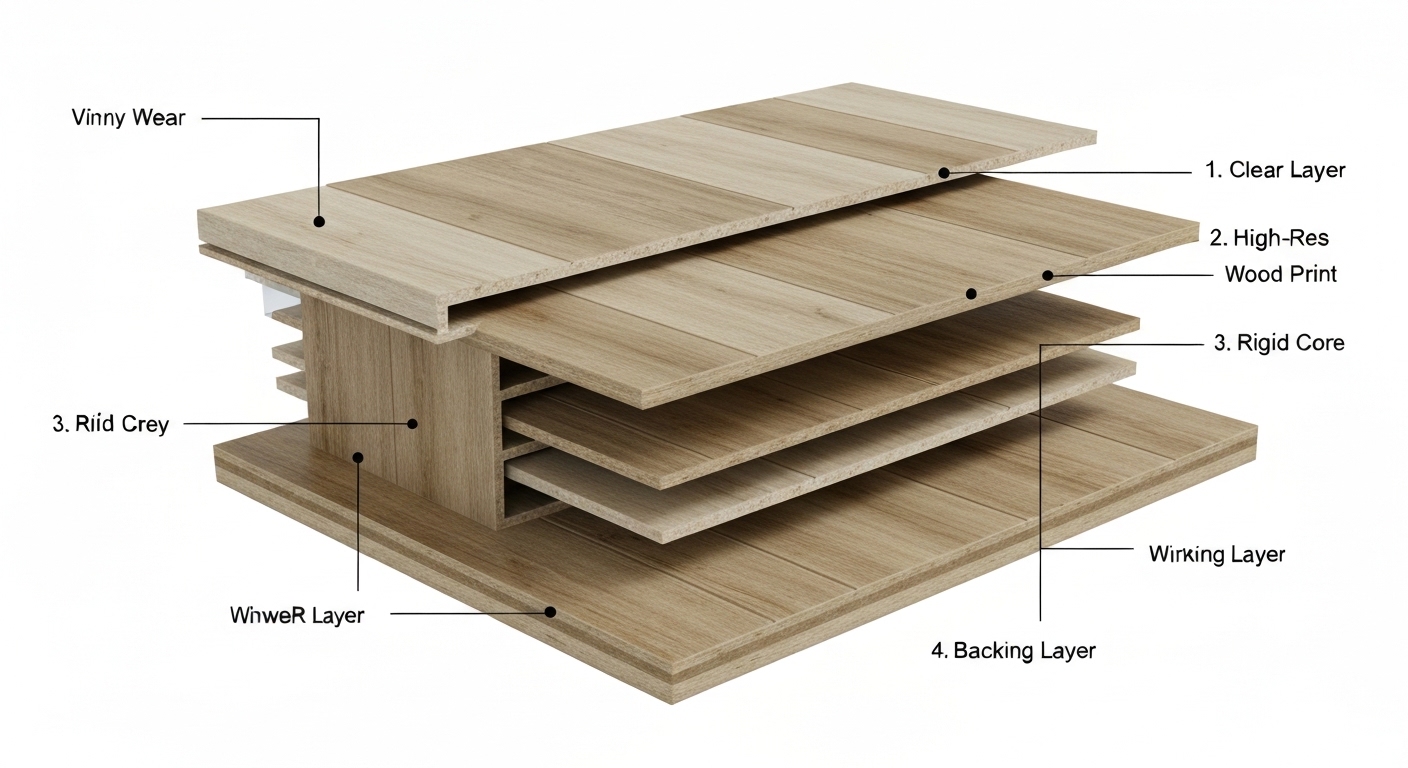
Vinyl Flooring Types Compared
Section titled “Vinyl Flooring Types Compared”| Flooring type | Typical structure | Primary vulnerabilities | Cleaning rules that matter most | Realistic lifespan (with correct care) |
|---|---|---|---|---|
| LVP (LVT plank) | Composite core (SPC or WPC) + printed film + clear PVC wear layer + UV-cured urethane topcoat (often ceramic bead reinforced) | Wear-layer micro-abrasion, seam moisture intrusion, heat-related delamination, rubber antioxidant staining | Dry grit removal often, damp mop only, neutral pH only, no steam, no wax, avoid rubber-backed mats | 15 to 25 years depending on wear layer thickness and traffic |
| VCT | Homogeneous PVC binder + mineral filler (limestone) tile, porous surface | Finish wear, black heel marks in finish, water staining if finish fails | Must be finished (waxed) and periodically scrubbed or stripped and recoated, neutral cleaners between cycles | 20+ years with planned finish maintenance |
| Sheet vinyl | Printed PVC sheet + backing (felt or fiberglass), fewer seams | Tears, indentation, staining from dyes and solvents, edge lifting if water gets under | Neutral pH, avoid harsh solvents and standing water at edges, protect from cuts and point loads | 10 to 20 years depending on thickness and exposure |
Buyer and use-case guidance
Section titled “Buyer and use-case guidance”For rentals and busy households, LVP is popular because it is replaceable plank-by-plank, but the topcoat is still thin and can be permanently dulled by abrasion or wrong cleaners. For basements, the practical risk is not surface water, it is moisture under the floor, which can drive odor, mold, and joint movement. For clinics, schools, and corridors, VCT remains common because finish maintenance is predictable and can be restored repeatedly without replacing the substrate.
The Wear Layer, and Why You Cannot “Refinish” LVP
Section titled “The Wear Layer, and Why You Cannot “Refinish” LVP”Most LVP surfaces are not bare PVC. They are protected by a UV-cured urethane topcoat, often reinforced with micro-ceramic or aluminum oxide particles that raise abrasion resistance.
That coating is hard, but thin (commonly 12 to 20 mil, sometimes lower or higher). If you abrade through it using steel wool, aggressive pads, powdered cleansers, or repeated melamine scrubbing, you expose the printed film and soft PVC underneath, then the pattern loss can progress quickly.
LVP is therefore a coating-preservation problem, not a refinishing problem. You protect it by reducing grit abrasion and avoiding anything that chemically dulls or softens urethane.
Why Steam Mops Destroy LVP (Delamination, Cupping, Haze)
Section titled “Why Steam Mops Destroy LVP (Delamination, Cupping, Haze)”Steam mops combine three stressors that resilient plank systems are not designed to tolerate at seams. Steam temperature (about 100°C or 212°F) can exceed the thermal comfort zone of some layer adhesives and can accelerate creep in certain polymer systems.
Pressurized vapor is pushed into click-lock joints that are tight but not watertight. Once moisture migrates under the plank, you can see edge curl (cupping), buckling, microbial growth, and long drying times because the assembly behaves like a moisture trap—conditions that commonly prompt searches for fixing bubbled vinyl flooring and delamination.
Heat can also haze urethane coatings (a blushing or clouding effect) and can shorten the life of factory finishes. Most major LVP warranties treat steam as a prohibited cleaning method, and the failure mode is consistent with polymer adhesion and moisture transport mechanics.
Cleaning With Neutral pH Cleaners (What “Neutral” Means in Practice)
Section titled “Cleaning With Neutral pH Cleaners (What “Neutral” Means in Practice)”Neutral pH cleaners minimize urethane dulling and reduce the risk of extracting plasticizers from PVC-rich layers. Acidic cleaners (including vinegar solutions) can gradually reduce gloss by etching and swelling mechanisms at the coating surface, while strongly alkaline products can strip finish layers and leave a residue that attracts soil.
For routine damp mopping, follow the manufacturer’s dilution precisely, because over-concentration is a common reason for sticky films. As a conservative DIY option, use a very small surfactant dose (about 1 to 2 mL mild dish soap per gallon of water), then rinse with clean water if you see streaking or feel tackiness.
Common cleaner ingredients: safer vs higher-risk
Section titled “Common cleaner ingredients: safer vs higher-risk”Neutral pH does not mean every ingredient is harmless, especially when cleaning vinyl and plastic baseboards. Look for low-residue surfactants and avoid aggressive solvents unless you are spot-treating a specific stain.
Generally compatible for routine cleaning (when diluted): non-ionic surfactants, small amounts of alcohol solvents, chelants like citrate, and water-based, residue-controlled formulations designed for LVT. Higher-risk for finishes and appearance: ammonia, chlorine bleach, high-pH degreasers, abrasive powders, pine-oil cleaners that leave oily films, and acetone or ketone solvents that can fog or soften coatings.
Scuffs vs. Scratches: Diagnose Before You “Fix”
Section titled “Scuffs vs. Scratches: Diagnose Before You “Fix””If your fingernail does not catch, it is usually transfer on top of the finish (rubber, shoe dye, soft plastic), and you should lift it off with low-abrasion methods. If your nail catches, material has been removed, which is wear-layer damage, and cleaning alone will not restore the original optics.
Misdiagnosis causes most irreversible damage. Scrubbing a scratch harder only widens the micro-abrasion field, and sanding a scuff permanently lowers gloss because you are thinning the urethane topcoat.
Removing Rubber Heel Marks and Other Transfer (Safe Methods)
Section titled “Removing Rubber Heel Marks and Other Transfer (Safe Methods)”Rubber heel marks are commonly transfer friction, not a cut into the coating. The floor coating is harder than the rubber, so the rubber smears and adheres.
A clean tennis ball on a broom handle is a low-risk mechanical method because it uses friction and the felt texture without adding abrasive grit. For stubborn marks like shoe polish, marker, or paint transfer, isopropyl alcohol on a white microfiber cloth is typically the safest solvent approach for urethane topcoats, then wipe with water to remove residue.
Melamine sponges can work, but they are micro-abrasive (functionally very fine sandpaper). Use them sparingly, with minimal pressure, because repeated use can create permanent dull spots that are obvious in angled light.
Preventing Indentation From Furniture (Load, PSI, and Creep)
Section titled “Preventing Indentation From Furniture (Load, PSI, and Creep)”Indentation is not only about weight, it is about pressure (PSI), meaning the load divided by the contact area. A 300 lb refrigerator distributed across four small feet can impose far higher local pressure than a heavier sofa distributed across a wide base.
Polymeric cores, especially foamed WPC structures, can show time-dependent deformation (creep). Once compressed past a recovery threshold, the dent can become permanent even if the coating remains intact.
Use felt pads on chairs and tables, and use non-staining load-distribution cups under narrow feet for high loads like kitchen islands, pianos, safes, and refrigerators. Increase the contact diameter and you reduce PSI, which directly reduces dent risk.
Entry Mats, Rubber Backings, and Yellow Stains
Section titled “Entry Mats, Rubber Backings, and Yellow Stains”Yellow rectangles under rubber mats are often not “dirt,” they are chemical staining from rubber additives. Many rubbers contain antioxidant and antiozonant packages (commonly aromatic amines such as phenylenediamine derivatives) that can migrate and react with vinyl surfaces, creating colored chromophores that are not removable by cleaning.
Prevent this by avoiding rubber-backed mats on LVP and sheet vinyl unless explicitly labeled non-staining or colorfast. Prefer woven mats, PVC-backed mats verified as non-staining, or mats recommended by your flooring manufacturer.
Sunlight and UV Fading
Section titled “Sunlight and UV Fading”LVP and sheet vinyl are polymer systems, and polymers can change color under UV exposure. High UV zones near south-facing glass often show gradual fading or tone shift over years, and it tends to appear as a sharp rectangle where rugs used to sit.
The practical controls are UV-reducing window film, low-E glass, and rotating rugs to even out exposure. Once the printed film has photobleached, you cannot restore the original color without replacing material.
Vinyl Flooring Care Myths (Myth vs Fact)
Section titled “Vinyl Flooring Care Myths (Myth vs Fact)”Viral cleaning advice often conflicts with polymer coating chemistry. These are the recurring myths that lead to the most warranty-voiding damage.
Myth: Vinegar is a safe “natural” vinyl cleaner
Section titled “Myth: Vinegar is a safe “natural” vinyl cleaner”Fact: Vinegar is acetic acid, and repeated acidic exposure can reduce gloss and increase soil retention by subtly altering the urethane surface. Occasional spot use is different from weekly mopping, but routine vinegar cleaning is a long-term dulling mechanism.
Myth: Steam is safe because the floor is “sealed”
Section titled “Myth: Steam is safe because the floor is “sealed””Fact: Click-lock seams are not watertight under pressure and heat, and steam introduces both. The common outcomes, delamination, haze, cupping, and joint distortion, match known heat and moisture failure modes in layered polymer flooring.
Myth: “Waterproof” means you can wet mop or leave spills
Section titled “Myth: “Waterproof” means you can wet mop or leave spills”Fact: Waterproof commonly refers to the plank body, not your subfloor, seams, or the microbial risk of trapped moisture. Flooding joints repeatedly can drive water under the floor and create odor, mold, and dimensional issues even if the planks themselves do not rot.
VCT Care, and Why It Is the Exception
Section titled “VCT Care, and Why It Is the Exception”VCT is designed for a sacrificial acrylic finish system. The tile is relatively porous, so finish fills microtexture, improves cleanability, and takes wear that would otherwise damage the tile surface.
If you own VCT, the correct program is periodic scrub and recoat, with full strip and refinish when the finish yellows, powders, or loses adhesion. Do not apply wax or acrylic finish systems to urethane-coated LVP, because adhesion is poor and buildup becomes a soil-attracting haze that often requires harsh stripping.
Repair, but Only the High-Level Decisions (This Hub Stays Preventive)
Section titled “Repair, but Only the High-Level Decisions (This Hub Stays Preventive)”Vinyl repair success depends on whether the wear layer and printed film are intact. If the damage is only transfer on the surface, it is usually reversible. If the printed film is damaged, the defect is usually permanent because you cannot recreate the optical print and factory coating stack in place.
When damage is usually repairable
Section titled “When damage is usually repairable”Surface scuffs, rubber transfer, minor dulling from residue, and shallow scratches that do not breach the print layer can often be improved. Dull spots can sometimes be visually blended using an LVT-compatible acrylic restorer, but that is cosmetic masking, not restoration of the original urethane.
When vinyl flooring damage is not repairable (replace vs repair)
Section titled “When vinyl flooring damage is not repairable (replace vs repair)”Replace is typically the correct call when the printed film is breached, when delamination has started, or when the core has swollen from moisture exposure. Chemical yellowing from rubber mats is also effectively permanent because it is a chemical modification, not a removable stain.
If multiple planks show seam lift, widespread cupping, or recurring moisture odor, treat it as a system problem, not a cosmetic problem. Fix the moisture source first, then replace affected sections, because repeated drying cycles can leave residual deformation and weakened joint geometry.
Condensed repair pointers, with the right next step
Section titled “Condensed repair pointers, with the right next step”For deep gouges, filler sticks and color-matched putties can improve appearance, but they do not restore wear-layer strength, and they can wash out if not compatible. For bubbling, cupping, or seam distortion, the first step is always moisture and temperature control, then assessment of whether the core has permanently swelled.
Quick Care Card (Keep the Wear Layer Intact)
Section titled “Quick Care Card (Keep the Wear Layer Intact)”No steam, no vinegar routines, no abrasive pads, and no rubber-backed mats unless verified non-staining; for discoloration concerns, especially beneath area rugs, review guidance on cleaning yellowed linoleum under rugs. Dry-remove grit frequently, damp mop lightly with neutral pH chemistry, and lower PSI under furniture feet with pads or cups.
References
Section titled “References”- Mannington Mills, Luxury Vinyl Plank Maintenance Guide.
- Armstrong Flooring, The Chemistry of Floor Finishes.
- World Floor Covering Association, Resilient Flooring Maintenance Guide.
- Shaw Floors, LVP Installation and Warranty Specifications (cleaning method exclusions).
- Literature on polyurethane coating chemistry and cleaning-induced gloss change mechanisms.