The PVC Care & Safety Guide (Code 3), Cleaning, Off-Gassing, and Phthalates
📑 Table of Contents
The PVC Care & Safety Guide: Identifying PVC (Number 3)
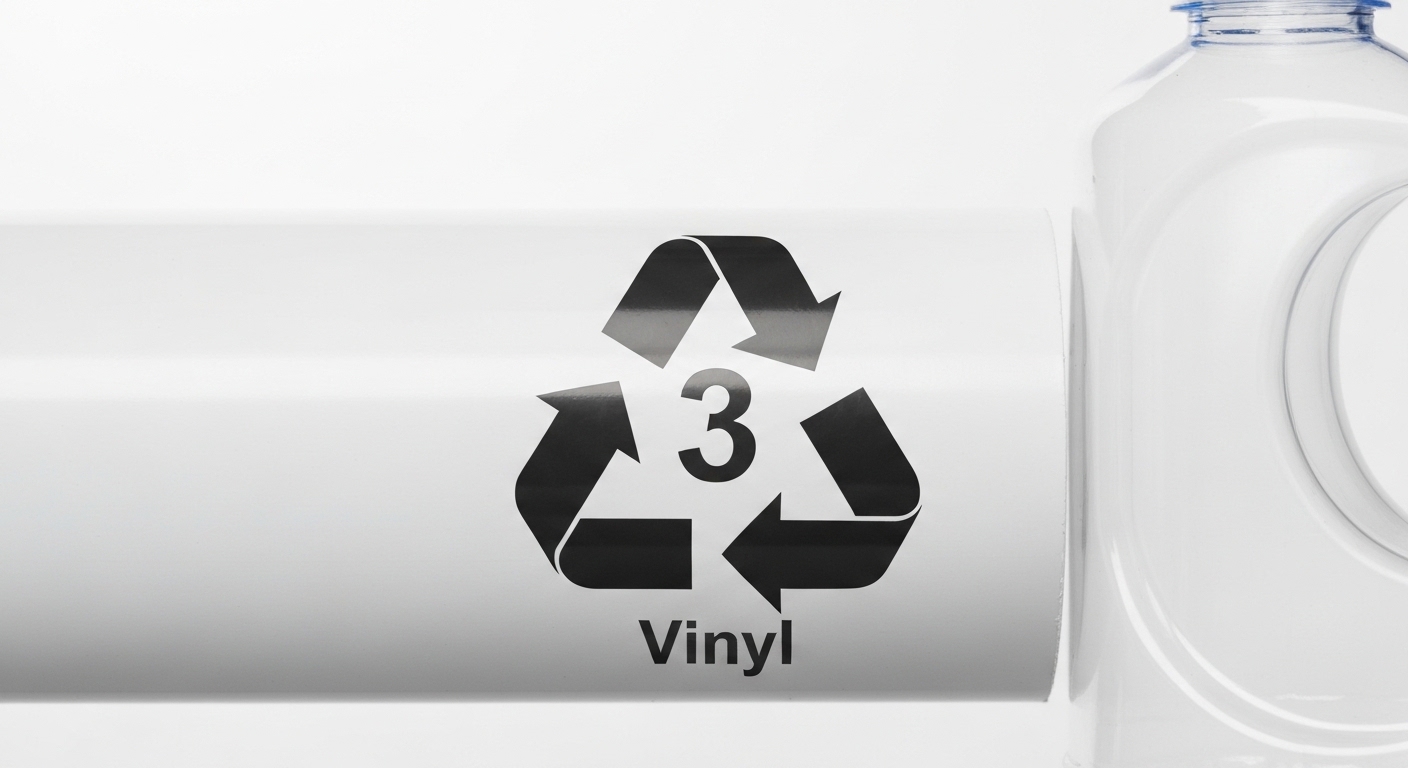
Section titled “The PVC Care & Safety Guide: Identifying PVC (Number 3)”Polyvinyl Chloride (PVC), often labeled “vinyl,” carries Resin Identification Code #3 and is one of the most common household polymers. After polyethylene (PE) and polypropylene (PP), it is among the highest-volume plastics used globally.
PVC is structurally distinct because it is the only major commodity plastic with substantial chlorine content (about 57% chlorine by mass). That chlorine increases chemical resistance and contributes to self-extinguishing behavior, which is why PVC is widely used for wiring, plumbing, and building products.
Raw PVC is rigid and relatively brittle. To make soft consumer goods like shower curtains, faux leather, inflatables, and garden hoses, manufacturers add plasticizers, historically dominated by phthalates.
Two families matter for care and safety decisions.
uPVC (unplasticized PVC) is rigid, used for pipes, window frames, and siding. Flexible (plasticized) PVC is soft, used for curtains, hoses, cable jackets, and many “vinyl” textiles.
If the #3 mark is missing, there are practical clues. A hot needle test can produce a sharp, chlorine-like odor with irritating acidic fumes, and flexible PVC often has a slightly oily or waxy feel from plasticizer migration.
Is PVC safe? A use-case verdict (household)
Section titled “Is PVC safe? A use-case verdict (household)”PVC safety depends on formulation (rigid vs flexible, stabilizer system, plasticizer package) and how you use it (heat, ventilation, UV exposure). Rigid uPVC used for pipes, siding, and window frames is generally a low-exposure material in normal service because it contains little to no plasticizer and is not designed to be mouthed or heated.
Flexible PVC is where exposure questions concentrate, because plasticizers can migrate, volatilize, or leach. If an item smells strongly, feels tacky, or is intended for hot water, food contact, or children’s mouthing behavior, PVC is usually the wrong choice.
PVC Safety Rules (featured snippet)
Section titled “PVC Safety Rules (featured snippet)”- Never heat PVC (microwave, dishwasher heat cycles, boiling water, direct sun-heating for “softening”).
- Never burn PVC (bonfires, fireplaces, construction debris piles).
- Ventilate new flexible PVC items outdoors until odor is minimal.
- Paint or shield outdoor PVC to slow UV damage (especially pipes and fencing).
The “New Shower Curtain” smell (VOCs) and phthalates
Section titled “The “New Shower Curtain” smell (VOCs) and phthalates”That sharp “new vinyl” odor is primarily VOC off-gassing from flexible PVC formulations, plus semi-volatile plasticizers that can partition into air and dust. Flexible PVC can contain a large plasticizer fraction, often tens of percent by weight, because the PVC backbone itself is inherently rigid.
A key materials point is that most plasticizers are not covalently bound to the PVC chain. They are physically blended into the polymer matrix, so they can diffuse to the surface over time, then volatilize slowly or transfer into water films, skin oils, and household dust.
Phthalates such as DEHP and DINP are historically common, and many have strong toxicological concern as endocrine-active substances. Modern products are increasingly formulated with lower-volatility, higher-molecular-weight plasticizers or non-phthalate alternatives, but “vinyl smell” is still a reliable indicator of a high-migration formulation or high residual solvent content.
Regulatory context matters when you evaluate risk. In the EU, REACH restricts several phthalates (including DEHP, DBP, BBP, and DIBP) in many consumer articles, and in the United States CPSIA limits certain phthalates in children’s toys and childcare articles, which pushed major manufacturers away from legacy plasticizer packages in products aimed at kids.
Those rules do not guarantee that every low-cost import is well-controlled, and they do not eliminate off-gassing from all additives. If you buy a flexible PVC curtain, liner, or garment bag, treat initial off-gassing as a real exposure event.
Ventilate new items outdoors for 24 to 48 hours, ideally with airflow and mild warmth. Avoid baking in intense sun for thin films because heat accelerates diffusion and can warp, but normal outdoor airing dramatically reduces indoor VOC peaks.
PVC vs PEVA for shower curtains (quick comparison)
Section titled “PVC vs PEVA for shower curtains (quick comparison)”| Property | PVC (flexible vinyl) | PEVA (PE/EVA blend) |
|---|---|---|
| Chlorine content | High (chlorinated polymer) | None |
| Plasticizer requirement | Often yes (migration possible) | Typically no |
| Initial odor | Common | Usually low |
| Heat tolerance in use | Poor choice for heat exposure | Better, but still not for high heat |
| Tear strength | Often higher | Often lower (can stretch or tear easier) |
| Long-term aging | Can embrittle as plasticizer is lost | Can stiffen with oxidation, usually slower odor issues |
| Recycling reality | Rarely curbside | Still inconsistent, sometimes accepted as film in special streams |
Cleaning “pink mold” from vinyl (why it happens)
Section titled “Cleaning “pink mold” from vinyl (why it happens)”Pink or orange slime along shower curtain hems is commonly Serratia marcescens, a bacterium that thrives in moist, soap-rich biofilms. Flexible PVC can worsen this because plasticizer migration and off-gassing can create a slightly oily surface that holds soil and can serve as an accessible carbon source for some microbes, a process similar to what’s described in PVC off-gassing and plasticizer migration explained.
The most consistent control strategy is removing biofilm mechanically, then using a disinfectant compatible with PVC; for practical guidance on how to safely clean and maintain household PVC, it helps to follow established cleaning practices. PVC tolerates dilute sodium hypochlorite well because the polymer is already chlorinated, but you still need proper ventilation and dilution discipline.
The standard wash method works because agitation strips biofilm while bleach kills residual colonies. Warm water helps dissolve soap scum, but avoid hot cycles for thin-gauge liners that can deform.
Restoring “stiff” PVC liners (plasticizer loss)
Section titled “Restoring “stiff” PVC liners (plasticizer loss)”Flexible PVC often becomes crunchy, stiff, and eventually cracks because plasticizer content declines over time. Plasticizer loss occurs by diffusion to the surface, volatilization into air, extraction into water films, and transfer into oils and detergents.
Once the plasticizer fraction drops below what the formulation needs for flexibility, the material reverts toward rigid PVC behavior. For thin films, that means brittle fracture during folding.
Re-softening is not chemically realistic for the bulk material; while surface conditioners can make vinyl feel slick, they do not rebuild the original internal plasticizer distribution that controlled glass transition and toughness, a limitation explained in more detail in this PVC care and safety guide for shower curtains.
If a liner has turned stiff or is cracking, it has reached end-of-life. Discard it rather than forcing folds that can create sharp shards.
Why PVC pipes yellow and crack (UV degradation timeline)
Section titled “Why PVC pipes yellow and crack (UV degradation timeline)”Rigid uPVC pipes and fencing yellow primarily from UV-driven dehydrochlorination. UV energy can break C to Cl bonds, releasing HCl inside the polymer, and that HCl can autocatalyze further chain dehydrochlorination, producing conjugated polyene sequences that shift color toward yellow and brown.
A simple field timeline is useful for inspections.
Year 0 to 1, surface gloss dulls slightly and fine dust accumulation becomes harder to rinse. Year 2 to 5, noticeable yellowing appears on sun-facing sides and the surface can begin to chalk.
Year 5 to 10, chalking increases, impact strength drops, and cracking risk rises, especially at stress concentrators like notches, threaded regions, and supports. Indoors, where UV is low, this process can be very slow, while outdoors it accelerates dramatically, particularly at high elevation, in hot climates, and under reflected UV from water or light-colored surfaces.
Paint is the most effective household mitigation because it blocks UV photons from reaching the polymer. Use an opaque, water-based exterior latex coating, and prioritize exposed pool plumbing and fence posts.
Safety: the phthalate and lead stabilizer issue
Section titled “Safety: the phthalate and lead stabilizer issue”Phthalates are not the only legacy concern in vinyl. Historically, some PVC formulations used lead salts as heat stabilizers during processing, and while many markets have moved to calcium-zinc or organotin stabilizers, older products and low-oversight imports can still be problematic.
When vinyl degrades by UV and abrasion, it can generate fine dust. If that dust contains lead from stabilizers or pigments, it becomes a direct household exposure pathway, particularly for children through hand-to-mouth behavior.
The mini-blind issue illustrates the mechanism. Sunlight embrittled and chalked low-cost vinyl blinds, releasing lead-containing dust that settled on floors and sills.
If you have old, chalky vinyl blinds, treat them as potentially contaminated. Avoid dry dusting, remove gently, bag for disposal, and replace with verified lead-free alternatives.
Cleaning vinyl siding oxidation (uPVC)
Section titled “Cleaning vinyl siding oxidation (uPVC)”Vinyl siding chalking is often the release of pigment and filler as the polymer binder weathers. Titanium dioxide protects PVC as a UV blocker, but as the surface erodes, that pigment can appear as a white haze that dulls color.
Avoid high-pressure washing because water driven behind panels can wet structural layers and raise mold and rot risk. A soft-wash approach using mild surfactant action and gentle brushing removes surface oxidation without damaging the building envelope.
Rinse thoroughly and avoid strong solvents that can swell the surface. If mildew is persistent, use a siding-safe mildewcide per label directions rather than increasing bleach concentration indiscriminately.
Removing scuffs from PVC flooring
Section titled “Removing scuffs from PVC flooring”Luxury vinyl plank (LVP) is a layered system that uses a PVC wear layer, sometimes with a polyurethane topcoat. Scuffs are often rubber transfer from shoes, not a true gouge.
A melamine sponge can remove transfer because the foam acts as a micro-abrasive. Keep it wet, apply light pressure, and stop as soon as the mark lifts to avoid dulling the finish.
For deeper flooring care and wear-layer specific advice, see the dedicated guide on Luxury Vinyl Plank.
Repairing tears in vinyl with solvent welding
Section titled “Repairing tears in vinyl with solvent welding”PVC can be solvent welded because certain solvents temporarily dissolve and swell the amorphous regions of the polymer, allowing chains to interdiffuse across a joint. Products like HH-66 vinyl cement use solvent systems (often including MEK or THF derivatives) that create a true fused bond after evaporation, not a simple adhesive layer.
This approach is appropriate for pool liners, inflatables, and tarps when used with ventilation and proper PPE. Solvents are flammable and can be neurotoxic at high exposure, so treat them as serious chemicals, not craft glue.
Surface prep matters because plasticizer-rich surfaces can reduce bond strength. Degrease lightly, follow the cement instructions, and allow full cure before pressure or immersion.
The garden hose leaching science (hot water accelerates migration)
Section titled “The garden hose leaching science (hot water accelerates migration)”Many common garden hoses are flexible PVC designed to remain bendable at lower temperatures, which historically meant higher plasticizer loading. Under sun exposure, water inside a hose can heat substantially, and diffusion-driven migration of additives into water increases with temperature.
First-draw hose water is the highest-risk fraction because it has had the longest contact time at elevated temperature. Even when the hose itself is compliant with certain product standards, fittings, pigments, and recycled content can contribute metals and organics that you do not want in drinking water.
Do not drink from a standard hose. Let the water run until it is cold before filling kiddie pools or pet bowls, and use hoses specifically labeled for potable water (often polyurethane or certified rubber) for RV and marine use.
Cleaning vinyl windows safely (uPVC)
Section titled “Cleaning vinyl windows safely (uPVC)”uPVC window frames scratch more easily than many people expect. Abrasive cream cleansers can create micro-scratches that trap dirt, which makes frames look gray faster over time.
Use mild surfactants like diluted dish soap and a microfiber cloth. Avoid repeated bleach exposure on uPVC because it can contribute to surface dulling and yellowing, especially if residues are left behind.
For stubborn marks, specialty uPVC cleaners used in the building trades can remove soil without heavy abrasion. Spot test first, because aggressive solvents can soften seals and printed finishes.
Identifying PEVA as a safer alternative (and its limits)
Section titled “Identifying PEVA as a safer alternative (and its limits)”PEVA is commonly marketed as a safer shower curtain material because it contains no chlorine and typically does not require phthalate plasticizers to achieve flexibility. Chemically it is a polyethylene and vinyl acetate copolymer blend, and in many household uses it reduces odor and migration concerns compared with flexible PVC.
PEVA is not a perfect material, and the limitations should guide your expectations. It often has lower tear resistance than thick vinyl, can feel less “drapey,” and its heat tolerance is still not a license for high-heat washing or dryer cycles.
If durability under mechanical abuse is the top priority, a higher-grade fabric curtain with a washable liner can outperform both PVC and PEVA. If chemical exposure and odor are the priority, PEVA is usually the better compromise.
Why PVC should never be heated (thermal decomposition and dioxins)
Section titled “Why PVC should never be heated (thermal decomposition and dioxins)”PVC softens at relatively low temperature but can decompose at higher temperatures, releasing HCl and forming a complex mixture of chlorinated organics under uncontrolled burning conditions. Dioxins and furans can form in fires when chlorine-containing materials burn in oxygen-limited environments, and these compounds are persistent, bioaccumulative, and toxic.
Household rules follow directly from the chemistry. Avoid microwaving PVC, avoid dishwashers for PVC items that see high heat, and never burn vinyl scrap or construction offcuts.
Environmental impact of PVC (lifecycle trade-offs)
Section titled “Environmental impact of PVC (lifecycle trade-offs)”PVC’s chlorine chemistry is central to both its utility and its environmental complexity. The chlorine feedstock is commonly produced via chlor-alkali processes, and vinyl chloride monomer production has significant industrial controls because the monomer is acutely hazardous.
Recycling PVC is technically possible but operationally difficult. PVC has many formulations (rigid, flexible, foamed, filled, fiber-reinforced), plus diverse additive packages (stabilizers, plasticizers, flame retardants, pigments) that do not blend safely, and small amounts of PVC contamination can damage melt processing of PET and polyolefin recycling streams.
Curbside programs rarely accept PVC for three practical reasons: low and inconsistent volumes, high sorting burden, and high risk of cross-contamination. For building products like pipes and siding, specialized construction and demolition recycling streams or manufacturer take-back programs are more realistic than household bins.
From a durability standpoint, long-lived uPVC in building envelopes can be a net positive if it prevents frequent replacement. From a chemical footprint standpoint, flexible PVC that off-gasses, migrates additives, and has short service life is often a poor lifecycle choice compared with less additive-intensive polymers.
PVC vs other household plastics (safety, heat tolerance, longevity)
Section titled “PVC vs other household plastics (safety, heat tolerance, longevity)”| Material | Typical household examples | Relative heat tolerance | Additive migration risk | Longevity in normal indoor use |
|---|---|---|---|---|
| PVC (rigid uPVC) | Pipes, window frames, siding | Moderate for service temps, not for cooking | Low (little plasticizer) | High |
| PVC (flexible) | Shower liners, hoses, inflatables | Low, avoid heat | Moderate to high (plasticizers, stabilizers) | Medium, often embrittles |
| PE (HDPE/LDPE) | Bottles, bins, films | Moderate, varies by grade | Low to moderate (less additive need) | High |
| PP | Food containers, housewares | Higher than PE, still not for extreme heat | Low to moderate | High |
| Silicone | Bakeware, seals | High | Low (but can absorb oils) | High |
| TPU | Phone cases, soft tubing, coatings | Moderate | Moderate (depends on plasticizers and hydrolysis stability) | Medium to high (grade-dependent) |
Long-term PVC care and storage (5 to 10 year performance)
Section titled “Long-term PVC care and storage (5 to 10 year performance)”PVC failure in homes is usually driven by three mechanisms: plasticizer loss (flexible items), UV oxidation and dehydrochlorination (outdoor rigid items), and stress cracking from repeated bending or impact. Your care strategy should reduce heat exposure, reduce UV dose, and minimize contact with oils and aggressive solvents that accelerate diffusion and swelling.
Store flexible PVC loosely rolled rather than folded to avoid crease cracking as it embrittles. Keep it in a cool, dark location because temperature increases additive diffusion rates and UV drives surface degradation.
Avoid prolonged contact with oily products (some polishes, insect repellents, certain sunscreens) because they can extract plasticizers and soften surfaces unevenly. For outdoor uPVC, paint or shield sun-facing surfaces, and inspect annually for chalking, yellowing, and hairline cracks near supports.
If you need deeper troubleshooting for specific symptoms (stiff curtains, yellowed window frames, flooring haze), this pillar is meant to guide material choices and risk boundaries rather than replicate every repair workflow. Use the linked dedicated guides where available.
References
Section titled “References”- Greenpeace, “PVC: The Poison Plastic, The Dioxin Connection.”
- Ecology Center, garden hose testing reports on lead, phthalates, and BPA.
- Journal of Vinyl and Additive Technology, mechanisms of PVC dehydrochlorination and stabilization.
- US EPA, phthalates action planning and chemical summaries.
- Healthy Building Network, assessments of phthalate-free PVC and alternatives.