Plastic Food Storage Leaching - Heat, Acid & Fat Risks
📑 Table of Contents
Migration Limits: FDA vs. Reality (The “Leaching” Science)
Section titled “Migration Limits: FDA vs. Reality (The “Leaching” Science)”“Leaching” is the colloquial term for chemical migration. In materials science, migration is the diffusion of substances from a polymer (or coating, gasket, ink, or adhesive) into the food it contacts.
Migrating chemicals generally fall into three categories, monomers (unreacted building blocks such as styrene or bisphenols), additives (plasticizers, antioxidants, UV stabilizers, slip agents, pigments), and non-intentionally added substances (NIAS) (impurities, reaction byproducts, and breakdown products formed during aging).
Regulators manage this through migration limits, but the limits do not mean “zero migration.” They mean “migration below a defined safety threshold under defined test conditions.”
Plastic Regulations Explained: FDA vs EFSA vs Reality
Section titled “Plastic Regulations Explained: FDA vs EFSA vs Reality”In the United States, the FDA regulates food-contact materials through mechanisms such as Food Contact Notifications and indirect food additive regulations (for example, PP under 21 CFR 177.1520). In the European Union, EFSA provides scientific opinions and the EU applies framework and specific measures (including overall and specific migration limits) with more explicit, harmonized migration testing requirements for many plastics.
A Specific Migration Limit (SML) is a cap on how much of a particular substance is allowed to migrate into food, usually expressed as mg/kg of food. The earlier reference value many people quote for BPA in food-contact plastics, 0.05 mg/kg, was an older EU-specific limit, and EU positions on BPA have tightened substantially in recent years as hazard assessments evolved.
Testing is typically performed with food simulants such as 3 percent acetic acid (acidic foods), ethanol solutions (hydrophilic foods), or olive oil and oil substitutes (fatty foods). The plastic is exposed to the simulant at specified time and temperature conditions meant to represent “foreseeable use,” which can be very different from a scratched, repeatedly dishwashed container used for years.
Compliance is valuable, but it is not proof of inertness. Real kitchens add stressors that are underrepresented in standardized tests, including repeated heating cycles, alkaline dishwashing detergents, abrasion, UV exposure, and “worst case” foods like hot fats and acidic sauces.
How Temperature Changes Leaching Rates (With Real Numbers)
Section titled “How Temperature Changes Leaching Rates (With Real Numbers)”Diffusion-driven migration is temperature sensitive because polymer chain mobility rises as temperature increases. This often follows an Arrhenius-type relationship where the diffusion coefficient increases approximately exponentially with temperature, meaning small increases in temperature can produce large increases in migration rates.
A practical rule is that each 10°C increase can roughly double to triple diffusion rates for many small molecules in polymers, depending on the polymer and migrant. That heuristic is consistent with polymer physics and is why heating events dominate lifetime exposure even if you store most foods cold.
Consumer thresholds that are easy to remember: below 40°C (104°F) migration is generally far slower, above 60°C (140°F) diffusion accelerates noticeably, and near 100°C (212°F) you can see step-changes from softening, warping, seal failures, and higher additive mobility. Microwave heating is a special case because it can create localized temperatures well above the measured “average” temperature.
The “Acid Factor” (Tomato Sauce)
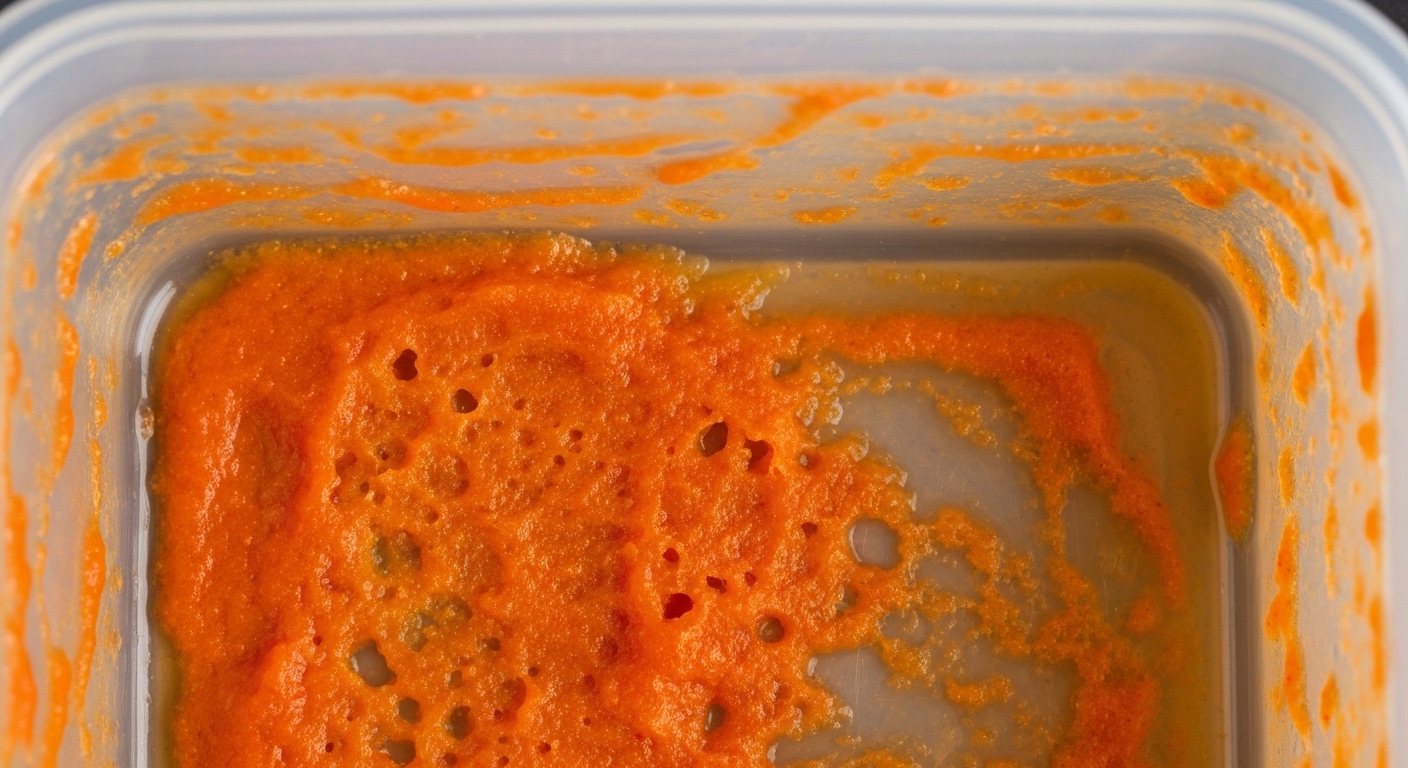
Section titled “The “Acid Factor” (Tomato Sauce)”Acidic foods (low pH) can increase migration by acting as an extracting medium and by accelerating chemical reactions that generate new migrants. Tomato sauce (often around pH 3.5 to 4.5), lemon juice, vinegar, and many fermented foods can pull certain additives, pigments, and metal ions into solution more effectively than neutral foods.
Polycarbonate (PC) is particularly vulnerable because hydrolysis and stress cracking pathways can increase release of bisphenols from the network. Acidic foods also attack reactive metals, so storing acids in aluminum containers can increase aluminum ion dissolution.
A conservative household rule is to avoid long-duration storage of acidic foods in plastic, especially if the container is older, scratched, or exposed to heat. Glass jars are a robust choice for foods at pH below 4.0, including many tomato products and pickled items.
The “Fat Factor” (Butter, Cheese, Oils)
Section titled “The “Fat Factor” (Butter, Cheese, Oils)”Many common plastic additives are lipophilic, meaning they partition into fats. The chemistry is straightforward, hydrophobic molecules prefer hydrophobic media, and fatty foods behave like mild organic solvents.
This is why high-fat foods are frequent “worst cases” in regulatory testing, using olive oil or oil-like simulants. It is also why soft plastics and flexible seals, which often rely on plasticizers or other low-molecular-weight additives for performance, can be higher contributors to food contamination.
A kitchen reality check is the “butter test.” If butter stored in a soft plastic tub develops off-odors or a plastic taste at the contact surface, you are observing sensory-level evidence that volatile or semi-volatile species are transferring.
Long-Term Exposure: What Repeated Low-Dose Leaching Means
Section titled “Long-Term Exposure: What Repeated Low-Dose Leaching Means”Migration is usually low per event, but exposure can become meaningful when it is repeated daily across many sources. Humans are exposed to mixtures, not single chemicals, and low-dose exposures can matter when chemicals share endocrine-active modes of action.
For endocrine disruptors such as certain bisphenols and phthalates, concern is not limited to acute toxicity. The concern is that chronic exposure during sensitive windows (pregnancy, infancy, puberty) may have outsized biological effects even when each individual source appears “within limits.”
This does not mean every plastic container is dangerous, but it explains why “approved for food contact” is not equivalent to “best choice for repeated hot, fatty, or acidic use.” If you reduce heat contact and retire degraded containers, you lower cumulative exposure without needing to identify every chemical in the material.
Why “Old” Plastic Leaches More (Aging, Oxidation, Dishwashers)
Section titled “Why “Old” Plastic Leaches More (Aging, Oxidation, Dishwashers)”A new polypropylene container often has a relatively smooth surface and intact semi-crystalline morphology that slows diffusion. With time, that barrier function degrades through physical abrasion and chemical oxidation.
Scratches increase effective surface area and create micro-cavities that hold oils and residues, maintaining longer contact time between food and polymer. Oxidative degradation (from UV, heat, and oxygen) can break polymer chains, create polar oxidation products, and increase free volume, all of which can increase permeability and additive mobility.
Dishwashers accelerate aging because high heat, repeated cycles, and alkaline detergents promote surface oxidation and stress cracking for some plastics. If a container becomes cloudy, chalky, warped, or develops persistent odors, its chemistry and diffusion behavior are no longer comparable to when it was tested “new.”
Phthalates vs. Bisphenols (Different Families, Different Uses)
Section titled “Phthalates vs. Bisphenols (Different Families, Different Uses)”Bisphenols (BPA, BPS, and related analogs) are used in certain rigid plastics and coatings, historically including polycarbonate and some epoxy can linings. Many bisphenols show estrogen receptor activity in assays, which is why they are discussed as endocrine disruptors.
Phthalates (such as DEHP and others) are most associated with flexible PVC and some elastomers, where they provide softness and flexibility. Many phthalates are anti-androgenic in toxicology literature, and exposure is often linked to flexible plastics, tubing, and some lid gaskets or seals rather than rigid tubs.
A “BPA-free” label only means BPA is not intentionally used; it does not guarantee the absence of other bisphenols, phthalates, or NIAS, nor does it address broader chemical migration risks in non-traditional food-safe plastics. Safety ultimately depends on the full formulation, the polymer type, and how the item is used.
The “Microwave” Accelerator (Why It Spikes Migration)
Section titled “The “Microwave” Accelerator (Why It Spikes Migration)”Microwaving accelerates migration because heat increases diffusion, and because heating is spatially non-uniform. Local hot spots can exceed 100°C (212°F) even when the bulk food temperature seems lower, especially in viscous foods like sauces or foods with uneven water content.
Peer-reviewed studies consistently show higher release of additives, monomers, and microplastic particles when plastics are exposed to hot liquids and repeated heating cycles, a context that underscores what BPA-free plastic really means for food safety. A widely cited example is infant polypropylene feeding bottles, where preparation with hot water and sterilization increased microplastic release by orders of magnitude under realistic use conditions (reported in Nature Food).
Polymer type matters because softening temperature, crystallinity, and additive load vary. Polypropylene generally performs better than polystyrene under heat, while polycarbonate and some styrenics are more prone to higher migrant release under thermal stress.
- Microwave worst offenders: polystyrene (#6) foam and rigid PS, older polycarbonate (#7) items, flexible PVC (#3) wraps or lids, and any container that is visibly scratched, warped, or heavily stained.
A “microwave safe” symbol primarily indicates the container will not melt or catastrophically deform under a basic test. It is not a guarantee of minimal migration in hot, fatty, or acidic foods.
Safe Plastics List (The Good Guys) With Limits and Failure Modes
Section titled “Safe Plastics List (The Good Guys) With Limits and Failure Modes”If you must use plastic, choose chemically simpler, lower-additive polymers and keep them out of high-heat, high-fat, and high-acid scenarios when possible. The resin code helps, but it is not a complete chemical disclosure.
| Polymer (resin code) | Typical practical temperature guidance | Typical additive profile | Common failure modes that increase migration |
|---|---|---|---|
| HDPE (#2) | Best for cold and room temp, avoid very hot fills | Antioxidants, slip agents, pigments in colored items | Stress whitening, odor absorption, surface oxidation with heat |
| LDPE (#4) | Good for cold storage, not ideal for heating | Slip agents, antioxidants, more permeable than HDPE | High permeability to oils and flavors, warping with heat |
| PP (#5) | Best among common rigid plastics for warm food, still avoid microwaving as a default | Antioxidants, nucleating agents, pigments | Dishwasher aging, surface oxidation, warping near high heat |
| Tritan (copolyester) | Often marketed for higher heat, still not ideal for microwaving fats | Stabilizers and processing aids vary by grade | Scratching, stress cracking with harsh detergents, unknown NIAS profiles depend on formulation |
This table is about risk management, not absolutes. Even “good” plastics can leach measurable amounts under aggressive conditions, while using them for cold, short-contact storage is generally lower risk.
Unsafe Plastics List (The Bad Guys) and Why
Section titled “Unsafe Plastics List (The Bad Guys) and Why”PVC (#3) is closely associated with plasticizers and can have higher migration potential into fats, especially when warmed. Polystyrene (#6) can release styrene-related compounds, with higher concern under heat and with oily foods.
Polycarbonate (#7, when PC) is the classic source category for bisphenols, especially in older items and under heat or mechanical stress. The “#7” category is a catch-all, so the code alone does not identify chemistry, but it is a signal to investigate before using it for food.
Best Alternatives to Plastic Food Storage (Use-Case Comparison)
Section titled “Best Alternatives to Plastic Food Storage (Use-Case Comparison)”Non-plastic options reduce additive migration risk and are more stable under heat, acids, and oils. The tradeoffs are breakability (glass), weight (glass and steel), seal design (silicone gaskets still matter), and visibility.
Glass is the most chemically inert option for acids and long storage, and it is excellent for reheating. Stainless steel is durable and inert for most foods, but it is not microwave-compatible and is not ideal for very salty or strongly acidic long contact if the grade is unknown.
Platinum-cured silicone can be useful for flexible storage and baking, but it can absorb odors and oils, and low-quality silicones may contain fillers that affect performance. Wax paper and parchment are good for short-contact wrapping of fats, especially cheese, because they avoid oil extracting additives from soft plastics.
Quick Reference Table: Food Type vs Safe Storage Material
Section titled “Quick Reference Table: Food Type vs Safe Storage Material”Use this as a conservative matrix when you are choosing containers for repeated, long-term use.
| Food or scenario | Highest-risk container types | Safest practical choices |
|---|---|---|
| Acidic foods (tomato sauce, citrus, pickles) | Old/scratched plastic, polycarbonate, unknown #7 | Glass (jar), glazed ceramic |
| Fatty foods (oils, butter, meats, nut butters) | Soft PVC, flexible lids and gaskets, thin disposable plastics | Glass, stainless steel, wax paper wrap (cheese) |
| Hot foods (freshly cooked, reheating) | Microwaving in any plastic, PS foam, old PP | Glass or ceramic for reheating, then transfer after cooling |
| Fermentation (weeks of acid plus bioactivity) | Plastic buckets with scratches and odor history | Glass or ceramic fermentation vessels |
Glass vs. Plastic for Fermentation
Section titled “Glass vs. Plastic for Fermentation”Fermentation creates a low pH, high ionic strength environment for weeks to months, with microbial metabolites that can interact with surfaces. Food-grade HDPE buckets are commonly used and can be acceptable for some applications, but they scratch and retain odors, which increases the likelihood of long-contact extraction.
If your goal is minimal chemical contribution from the vessel, glass and ceramic are the most inert options for long ferments. If you do use plastic, reserve a dedicated vessel, avoid abrasive cleaning, and retire it when surface damage becomes obvious.
Storing “Hot” Food (Cooling Protocol)
Section titled “Storing “Hot” Food (Cooling Protocol)”Avoid filling plastic with near-boiling foods because heat shocks the polymer and maximizes diffusion at the exact moment the concentration gradient is highest. There is also a mechanical issue, cooling creates a partial vacuum that can warp lids and sidewalls, permanently damaging the seal.
A practical protocol is to let food cool to about 60°C (140°F) before transferring into plastic, and to use glass for any reheating step. If you want a single-container workflow, store and reheat in glass.
Do “BPA Free” Liners Leach?
Section titled “Do “BPA Free” Liners Leach?”Many canned foods historically used BPA-based epoxy linings, and many products have shifted to “BPA-free” alternatives. These can include acrylics, polyesters, oleoresins, or other systems, and the migration profile depends on the exact formulation and curing.
Research has found that some BPA-free plastics and coatings can still show estrogenic activity or leach other compounds, which is why “free-from” claims are not the same as a full hazard assessment. The lowest-migration packaging choices for acidic foods are often glass jars or cartons with thin polyethylene layers, depending on the product.
The “Smell Test” for Leaching (Useful, Not Perfect)
Section titled “The “Smell Test” for Leaching (Useful, Not Perfect)”A strong chemical or fruity odor in a new plastic container indicates volatile organic compounds are present and outgassing. Odor is not a quantitative safety test, but it is a valid red flag for higher levels of volatile migrants.
For food contact, prefer containers that are as close to odorless as possible, and avoid using strongly odorous plastics for water, oils, or infant and child foods.
Leaching Reduction Plan (Most Impactful Controls)
Section titled “Leaching Reduction Plan (Most Impactful Controls)”The biggest exposure reductions come from controlling temperature, contact time, and food type; understanding how polypropylene food containers handle heat, acids, and fats can help guide safer choices. Use glass or ceramic for heating, keep acids and oils out of damaged plastics, and treat visible wear as a performance failure rather than a cosmetic issue.
FAQ (Featured Snippet Targets)
Section titled “FAQ (Featured Snippet Targets)”-
Does plastic leach into food? Yes, most plastics can transfer small amounts of monomers, additives, or breakdown products into food by diffusion. The rate depends strongly on temperature, contact time, food chemistry (fat and acid), and the container’s age and wear. “Food safe” usually means below regulatory limits, not zero migration.
-
What foods cause the most leaching? Hot foods, fatty foods (oils, butter, meats), and acidic foods (tomato sauce, citrus, pickles) tend to increase migration. Heat accelerates diffusion, fats dissolve many additive-like molecules, and acids can extract ions or accelerate polymer degradation pathways. Scratched or dishwashed containers amplify all of these effects.
-
Is BPA-free plastic safe? BPA-free means BPA is not intentionally used, but it does not guarantee the absence of other bisphenols, phthalates, or NIAS. Safety depends on the polymer and formulation, plus how you use it (especially heat). For repeated hot or acidic use, glass remains the most inert choice.
References
Section titled “References”- National Institute of Environmental Health Sciences (NIEHS). Plastics, hormones, and health.
- Nature Food. Release of microplastics from infant feeding bottles during sterilization and simulated use.
- U.S. FDA. Bisphenol A (BPA): Use in Food Contact Application.
- Journal of Toxicology. Estrogenic chemicals often leach from BPA-free plastic products.