The Storage Bible - Maintenance & Safety for Food Containers
📑 Table of Contents
Quick safety checklist (TL;DR)
Section titled “Quick safety checklist (TL;DR)”When Should You Throw Away a Plastic Food Container?
Section titled “When Should You Throw Away a Plastic Food Container?”- Throw away if the inside feels rough, chalky, or your fingernail catches, this is surface micro-cracking that cannot be sanitized.
- Throw away if you see pitting or craters from microwaving, these are localized melt spots that trap residues.
- Throw away if it is warped, won’t seal, or leaks when filled with water and inverted, seal failure increases contamination risk.
- Avoid for hot, oily, or sugary foods if you routinely see new white rough spots after reheating, that is heat damage from localized superheating.
- Retire to non-food use if it is deeply stained and holds odors after proper washing and drying, porosity and absorbed organics are rising.
- Treat as display or dry storage if it is brightly colored “vintage” plastic from the 1970s or earlier, legacy pigments and additives are the main concern.
Plastic types used in food storage (comparison table)
Section titled “Plastic types used in food storage (comparison table)”| Plastic type | Typical resin code | Heat tolerance (practical kitchen use) | Staining tendency | Leaching risk profile (typical) | Expected lifespan (normal home use) |
|---|---|---|---|---|---|
| Polypropylene (PP) | #5 | Good for microwave reheating of water-rich foods, tolerates dishwasher better than PE | Moderate to high with tomato oils | Low for bisphenols, watch degradation and additives over time | 3 to 10+ years depending on dishwasher use |
| Low-Density Polyethylene (LDPE) | #4 | Lower heat resistance, can soften in very hot wash water | Moderate, especially with oils | Generally low, but older flexible parts can age poorly | 2 to 8 years, lids often fail first |
| High-Density Polyethylene (HDPE) | #2 | Better than LDPE, usually not ideal for repeated microwave heating | Lower than PP for many foods | Generally low, commonly used for food bottles and tubs | 3 to 10 years |
| Tritan copolyester | #7 (varies) | Good heat resistance, often dishwasher-safe, check brand limits | Lower than PP for many sauces | No BPA, additive package varies by manufacturer | 3 to 10 years, clarity may haze with abrasion |
| Polycarbonate (PC) | #7 | High heat resistance, historically popular for clear rigid containers | Lower staining, stays clear | Higher concern pre-2010 due to BPA use | 5 to 15 years mechanically, but regulatory concerns drive retirement |
Notes: “Heat tolerance” is not the same as “chemical stability under repeated alkaline detergent exposure.” A container can survive heat without melting while still developing surface oxidation, roughness, and micro-cracks that reduce hygiene.
Evolution of food storage, from PE to PP
Section titled “Evolution of food storage, from PE to PP”The history of airtight food containers tracks closely with post-war thermoplastics. Earl Tupper’s first designs in the 1940s used Low-Density Polyethylene (LDPE, Code 4), chosen for flexibility that enabled the patented “burping” seal.
LDPE had clear thermal limitations, it softens in hot water and is fundamentally incompatible with modern microwave use. As reheating convenience became standard, the industry migrated to Polypropylene (PP, Code 5), which has a higher melting point (about 320°F or 160°C) and better stiffness for repeatable seals.
Modern containers from major brands are commonly PP or Tritan copolyester. These materials largely solve deformation from heat, but they introduce different aging modes such as haze, micro-scratching, and long-term brittleness under harsh dishwasher conditions.
The “white chalky” residue mystery
Section titled “The “white chalky” residue mystery”A rough white haze inside aging containers is often mistaken for hard-water scale or soap film. In many cases it is actually polymer surface damage, commonly called crazing or micro-cracking, plus abrasion that converts a glossy surface into a matte, porous one.
Polypropylene is chemically resistant, but not immune to oxidation. Repeated exposure to high-pH dishwasher detergents, elevated wash temperatures, and heated drying accelerates chain scission near the surface and increases water uptake into micro-defects.
The “chalk” sensation is the polymer surface shedding at a microscopic level. Once the surface becomes porous, sanitizing becomes less reliable because residues and microbes can persist in micro-cracks beyond the reach of a sponge.
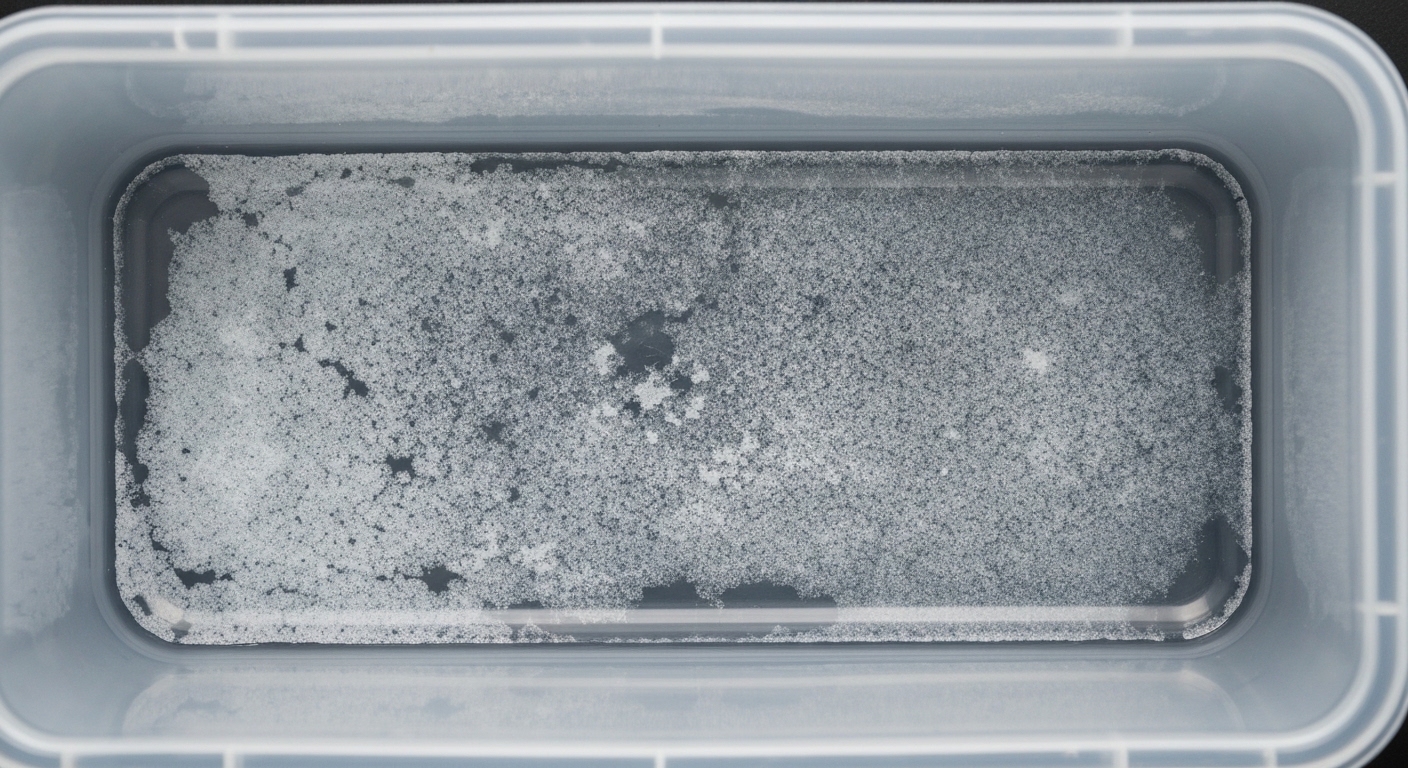
When a container turns chalky and rough, the surface is compromised. Retire it from wet food storage and repurpose it for dry organization.
Removing deep tomato stains (and peroxide myths)
Section titled “Removing deep tomato stains (and peroxide myths)”Tomato stains are driven primarily by lycopene and tomato oils, which are hydrophobic and lipophilic, a behavior often discussed in broader plastic food container safety and lifespan analysis. Polypropylene is also nonpolar, so hot oily sauces can partition into the polymer surface, making the discoloration closer to absorption than a simple surface stain.
Sunlight works because UV and oxygen promote oxidation of the conjugated double-bond structure that gives lycopene its red color. Bright direct sun for 4 to 6 hours can noticeably fade staining without adding reactive chemicals, although it cannot reverse damage if the container is already roughened.
Hydrogen peroxide is widely suggested online, but it is not a benign choice for PP over repeated use. Peroxide can accelerate oxidative embrittlement and can also create localized whitening that looks “clean” while increasing surface micro-cracking, so I treat it as a last-resort spot treatment rather than a routine method.
If you want the chemistry behind UV-driven fading, see this discussion of ultraviolet exposure and polymer reactions.
Solving the “sticky lid” syndrome
Section titled “Solving the “sticky lid” syndrome”Sticky, tacky lids usually indicate either oil polymerization on the surface or material degradation. Lids are often LDPE or LLDPE to stay flexible, and those formulations can show surface changes sooner than rigid PP bodies.
If the tackiness is from oxidized cooking oils, gentle abrasion and adequate detergent contact time can help. If the tackiness is the plastic itself breaking down, you are seeing migrating low-molecular-weight species, the surface will continue to weep and will eventually crack.
A degrading lid is chemically unstable. Replace it or retire the set, because sealing performance and hygiene both decline.
Microwave safety and the “pitting” phenomenon
Section titled “Microwave safety and the “pitting” phenomenon”White rough spots or craters after reheating are called pitting, and they are localized melting events. A “microwave-safe” label generally assumes the food behaves like water, but fats and sugars can exceed water’s temperature quickly.
Oil-rich foods and thick sugary sauces can superheat at contact points, pushing the polymer above its softening range in seconds. That creates permanent craters that trap residues and are difficult to sanitize.
Do not microwave high-fat or high-sugar foods in plastic when you can avoid it, even if the container is labeled microwave-safe. Transfer to ceramic or glass for reheating when practical.
Dishwasher vs. handwashing longevity (with realistic cycle estimates)
Section titled “Dishwasher vs. handwashing longevity (with realistic cycle estimates)”Dishwashers are hostile to plastic longevity for three reasons, heat, mechanical erosion from jets, and alkaline detergents. Even when PP does not visibly deform, the surface finish degrades, gloss drops, micro-scratches accumulate, and haze appears.
In accelerated aging studies and real-world kitchen patterns, noticeable surface dulling in PP commonly appears after roughly 150 to 300 dishwasher cycles, with sanitization confidence dropping as roughness rises. For many households that run 3 to 5 loads per week, that can mean 1 to 3 years to reach the “chalky” stage on frequently used containers, while handwashing can extend functional life into the 5 to 10+ year range depending on abrasion.
The most damaging settings are heated dry and sanitize cycles because they stack thermal stress onto caustic chemistry. If you must machine-wash, use the top rack, skip heated dry, avoid “sanitize,” and do not overload so items rattle and abrade.
Identifying “vintage” toxic Tupperware (a simple timeline)
Section titled “Identifying “vintage” toxic Tupperware (a simple timeline)”Vintage Tupperware is collectible, but its safety profile is different from modern food-contact plastics. The base resin (often PE) can be stable, yet older pigment systems and additive packages were not designed under today’s migration expectations.
Use this practical visual timeline.
- Pre-1980: Highest caution, especially bright opaque yellows, oranges, and reds, legacy heavy-metal pigments were more common and regulatory frameworks were less stringent. Treat as display or dry storage only.
- 1980–2000: Improved additive control, but still variable by manufacturer and product line, retire items that are scratched, chalky, or heavily stained.
- Post-2010: Broad shift away from BPA-containing polycarbonate in many consumer lines, clearer labeling around “microwave safe” and “top-rack dishwasher safe,” although wear mechanisms still apply.
If you are specifically evaluating bisphenols, see BPA for context on labeling and why “BPA-free” does not always mean “bisphenol-free.”
Why lids lose their “snap” (polymer fatigue)
Section titled “Why lids lose their “snap” (polymer fatigue)”A lid’s snap depends on elastic recovery and a precise interference fit. Over time, lids experience creep, meaning the polymer relaxes into the stretched shape if stored snapped on, reducing sealing force—a behavior commonly addressed in a food container heat safety and maintenance guide.
Heat cycling accelerates loss of dimensional stability. LDPE lids can shrink or warp differently than PP bodies, so even a small geometry change can turn a good seal into a leaker.
Once elastic memory is gone, it cannot be fully restored. Heat “resetting” can sometimes correct warping, but it does not reverse creep-driven relaxation.
Preventing freezer burn in plastic
Section titled “Preventing freezer burn in plastic”Freezer burn is dehydration driven by moisture migration into dry freezer air. Plastics are semi-permeable barriers, and LDPE is more gas-permeable than PP, so long storage is often limited by lid seal quality rather than container wall thickness.
Reduce headspace to minimize the amount of dry air available to pull water from food, leaving about 10% volume for expansion. For longer storage, a direct-contact barrier layer (wrap pressed to the food surface) reduces sublimation and slows odor transfer.
Storing nested containers to prevent odors
Section titled “Storing nested containers to prevent odors”Sealing containers for storage traps moisture and volatile compounds. If any residue remains, microbial growth and anaerobic byproducts can create persistent odors that diffuse into the polymer.
Store containers nested with lids off, or set lids on loosely without snapping. Airflow is a low-tech control that prevents odor build-up and reduces the need for aggressive cleaning.
The “baking soda” odor-pull
Section titled “The “baking soda” odor-pull”Baking soda is a useful deodorizer because it can neutralize acidic and some basic odor molecules, and it can act as a mild abrasive. A paste left in contact over time can help pull absorbed odors out of the near-surface region.
For stubborn odor cases, prioritize full drying between steps. Odor chemistry is strongly influenced by residual moisture left in micro-scratches.
BPA vs. BPS in major brands
Section titled “BPA vs. BPS in major brands”Pre-2010 polycarbonate (PC) food containers often relied on Bisphenol-A (BPA) chemistry. Many major brands transitioned toward Tritan copolyester or clarified PP around 2010–2012, but “BPA-free” labeling only guarantees BPA is not intentionally used.
Bisphenol-S (BPS) and other substitutes can appear in some “BPA-free” formulations. Polypropylene does not require bisphenols in its synthesis, so standard PP containers (often translucent or opaque) are typically the conservative choice when bisphenol exposure is the main concern.
For regulatory framing, the U.S. FDA states BPA is authorized for some food-contact applications, while also noting market shifts away from BPA in certain products. See the FDA’s consumer overview: https://www.fda.gov/food/food-additives-petitions/bisphenol-bpa-use-food-contact-application.
When to retire a container (detailed criteria)
Section titled “When to retire a container (detailed criteria)”A container that was safe when new can become harder to sanitize as it degrades, which is why evaluating condition—not just the recycling code—is essential; resources like the food container maintenance and safety bible can help guide decisions as wear and tear accumulate.
Texture is the most important indicator because roughness implies micro-cracks and increased surface area for residue retention. Pitting, warping, persistent odors, and permanent haze are also strong retirement signals because they reflect irreversible structural change.
Repairing warped lids (heat reset)
Section titled “Repairing warped lids (heat reset)”You cannot fix shrinkage, but you can sometimes correct warping from cooling in a bent position. The goal is to re-align the lid’s geometry without overheating it.
Immerse the lid in very hot (not boiling) water for about 2 minutes, then snap it onto the matching container and allow it to cool to room temperature in place. If sealing force does not return, the lid has likely undergone creep or material aging beyond reversible deformation.
Environmental impact and end-of-life
Section titled “Environmental impact and end-of-life”Reusing food containers usually has a lower environmental footprint than frequent replacement, but reuse stops being a net benefit when the item can no longer be cleaned effectively or when it begins shedding micro-fragments from a damaged surface. Chalky surfaces, heavy scratching, and pitting are practical indicators that mechanical wear is advancing, and those are also the conditions where microplastic generation during scrubbing is more plausible.
Recycling reality matters. PP (#5) and HDPE (#2) are more commonly accepted in municipal programs than mixed #7 items, but acceptance varies widely and depends on local sorting infrastructure, labels, and contamination.
Use the resin code as an end-of-life guide, not a safety guarantee.
- #2 HDPE and #5 PP: Often the best chance of curbside acceptance, rinse and dry, remove food residue, and follow local rules on lids.
- #4 LDPE and many #7 plastics: Frequently limited to store drop-off programs or not accepted, check your municipality, do not “wishcycle.”
Disposal can be safer than reuse when structural integrity is compromised. If the container is chalky, pitted, or persistently odorous, retiring it reduces hygiene risk and may reduce ongoing abrasion-related particle shedding during aggressive cleaning.
Best alternatives to plastic storage
Section titled “Best alternatives to plastic storage”Glass and stainless steel reduce concerns around staining and long-term surface oxidation, but lids are often still polymeric and seals can still trap residues. Borosilicate glass is chemically inert and excellent for reheating, while stainless steel is durable but not microwaveable and hides contents.
Silicone bags are convenient, but silicone is permeable to water vapor over long periods, so it is not always a perfect freezer solution. For many households, high-quality PP remains a practical choice when it is treated as a consumable with a finite service life.
References
Section titled “References”- American Chemistry Council. “Polypropylene Use in Food Packaging, Technical Guide.” Plastics Food Service Packaging Group. 2022.
- Consumer Product Safety Commission (CPSC). “Microwave Safety Standards and Plastic Interaction.” Laboratory Manual.
- National Institute of Standards and Technology (NIST). “Polymer Degradation in Alkali Environments (Dishwasher Simulation).” Journal of Research of NIST.
- Cooper, J.E. “Migration of Lycopene into Polypropylene Matrix.” Journal of Food Engineering. 2019.
- Erickson, M. “Bisphenol A and its analogues, Substitution in the industry.” Green Chemistry Letters.
- U.S. Food and Drug Administration (FDA). “Bisphenol A (BPA), Use in Food Contact Application.” https://www.fda.gov/food/food-additives-petitions/bisphenol-bpa-use-food-contact-application.
- Tupperware Brands Corporation. “Care and Use Guide, Vintage vs. Modern Collections.” Consumer Archive.