Styrofoam (Polystyrene) Safety & Usage Guide
📑 Table of Contents
The Styrofoam Guide: Identifying “Number 6” (PS)
Section titled “The Styrofoam Guide: Identifying “Number 6” (PS)”Polystyrene (PS) shows up in two common household forms, and both carry Recycling Code #6. Expanded polystyrene (EPS) is the white foam used in coffee cups, takeout clamshells, meat trays, coolers, and packing peanuts. Solid polystyrene is the clear, brittle plastic used for CD cases and some disposable cutlery.
“Styrofoam” is a trademark historically associated with extruded polystyrene (XPS) insulation, but most people use it generically for EPS food and packaging foam. From a chemistry standpoint, EPS, XPS, and solid PS share the same polymer backbone. Their behavior is dominated by the aromatic benzene ring side group, which makes PS rigid, glassy, and unusually vulnerable to many organic solvents compared with polyolefins like polyethylene and polypropylene.
Why PS Is Brittle and Heat-Sensitive
Section titled “Why PS Is Brittle and Heat-Sensitive”Solid PS is glassy at room temperature, meaning it has low ductility and cracks rather than yielding. Drop a CD case and it shatters because the polymer chains cannot dissipate impact energy well.
Heat is a second limitation. PS begins to soften as you approach boiling-water temperatures, and thin-walled foam products deform easily because the structure is mostly air and the polymer walls are very thin. In a microwave, localized hot spots can exceed 100°C even when the bulk food looks merely warm, and that is when EPS can warp, collapse, or shed fragments into food.
The “Solvent” Reaction: Why Gasoline Melts Foam
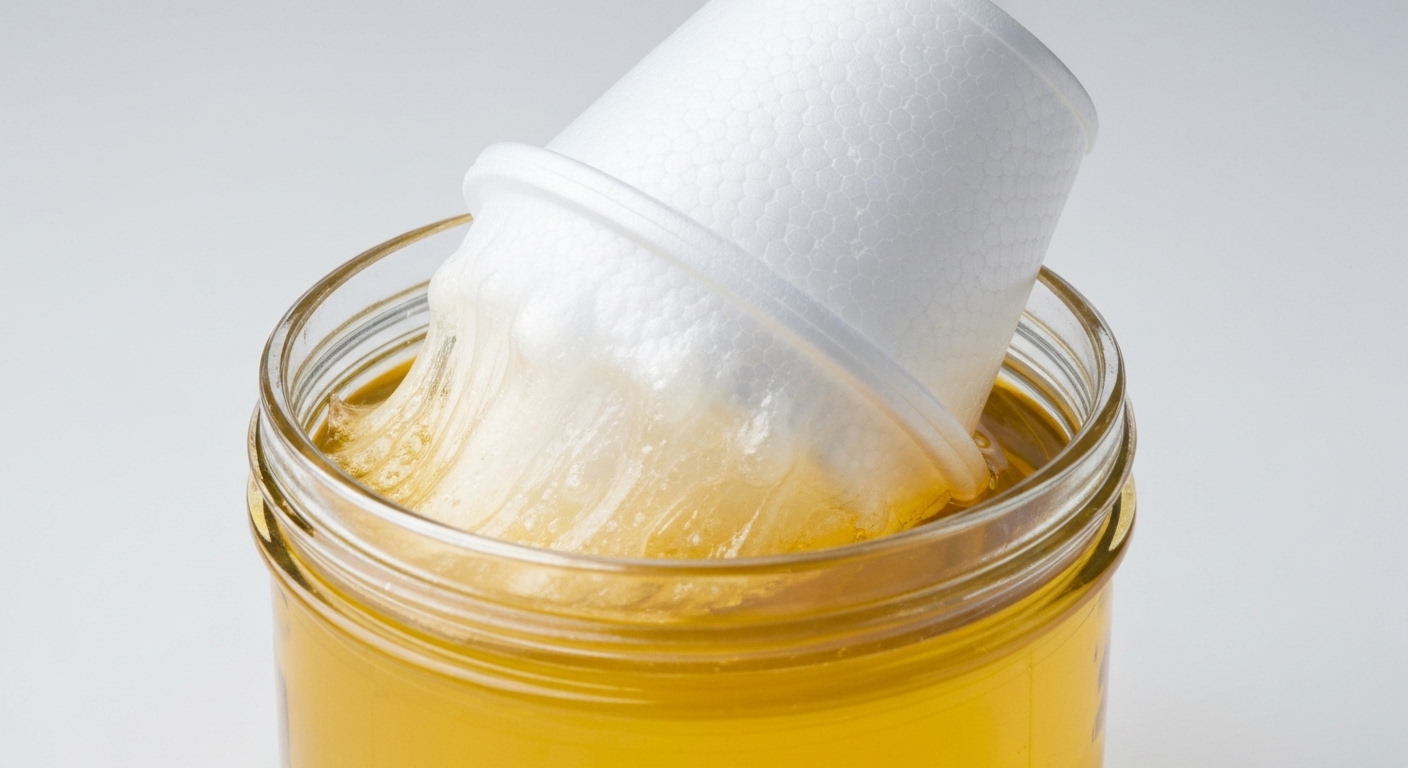
Section titled “The “Solvent” Reaction: Why Gasoline Melts Foam”EPS is typically around 95 percent air by volume, so a small mass of polymer occupies a large volume. Non-polar or moderately non-polar solvents can rapidly diffuse into PS, swelling it and dissolving polymer chains.
Gasoline and many paint thinners collapse EPS almost instantly, producing a sticky gel because the polymer is no longer held in a cellular foam structure. Acetone (nail polish remover) does the same, as do some terpene-rich essential oils like citrus oil. Treat EPS as incompatible with fuels, strong cleaners, paint products, and concentrated fragrance oils.
Safety: Styrene Leaching in Hot Coffee (Risk Framed Quantitatively)
Section titled “Safety: Styrene Leaching in Hot Coffee (Risk Framed Quantitatively)”Styrene is the residual monomer and a possible breakdown product associated with polystyrene, and it is listed by the U.S. National Toxicology Program as “reasonably anticipated to be a human carcinogen.” That classification reflects hazard identification, not a guarantee of harm from typical consumer exposures, so the practical question is dose.
Migration of styrene from PS or EPS into food increases with heat, contact time, acidity, and fat content. Hot coffee, especially with cream or milk, creates conditions that increase styrene transfer compared with cold water. In published migration studies under realistic use, styrene levels are typically reported in the low microgram-per-liter to tens of micrograms-per-liter range for hot beverages (order of magnitude: about 1 to 50 µg/L depending on temperature, time, and analytical method).
To put that into exposure context, a 350 mL serving at 10 µg/L corresponds to about 3.5 µg of styrene. That is a low dose relative to occupational exposure limits (which are set for inhalation in industrial settings), but it is not zero, and repeated daily exposure is the relevant concern for habitual users—especially when you consider related material chemistry issues, such as why solvents can melt polystyrene.
The risk framing is this: occasional use of EPS cups for hot coffee is not an acute poisoning scenario for healthy adults, but it is also not a “clean” material for hot, acidic beverages. If you want a practical hierarchy, keep EPS away from heat, fat, and long contact times, and favor inert food-contact materials for daily hot drink routines.
For broader context on household polymer exposure pathways and why shedding and fragmentation matter, see reduce household microplastic shedding.
Is Styrofoam Safe?
Section titled “Is Styrofoam Safe?”- Hot liquids: Mostly no for routine use. Occasional use is typically low acute risk, but heat and acidity increase styrene migration.
- Microwaving: No. Hot spots can deform EPS and increase migration, and the container can physically fail.
- Reusing food containers: No. Surface wear increases retention of oils and odors, and repeated heating increases extraction.
- Recycling: Rarely. Technically recyclable, but often rejected curbside and requires specialized logistics.
Why “Clear PS” Cups and Cutlery Crack
Section titled “Why “Clear PS” Cups and Cutlery Crack”Many clear disposable cups and brittle cutlery are PS because it molds well and looks glossy and clear. The tradeoff is poor strain tolerance, so small dents become cracks.
Polypropylene tends to bend rather than fracture, which is one reason it is favored for reusable food containers and hinged lids. If you must use PS partyware, avoid squeezing, twisting, or tightly nesting cups, since friction and wedging create stress concentrations that trigger splitting.
Identifying High-Impact Polystyrene (HIPS)
Section titled “Identifying High-Impact Polystyrene (HIPS)”High-impact polystyrene (HIPS) is polystyrene modified with rubbery polybutadiene domains, commonly around 5 to 10 percent. Those rubber particles blunt cracks and improve impact strength.
HIPS is typically opaque and used for refrigerator liners, appliance housings, and some yogurt cups. Structurally it is tougher than crystal PS, but from a chemical migration standpoint it remains a styrenic polymer and should not be treated as a high-heat food-safe material.
Cleaning Yellowed White PS Appliances (Retrobrighting)
Section titled “Cleaning Yellowed White PS Appliances (Retrobrighting)”Many vintage housings and appliance parts are HIPS with brominated flame retardant systems or brominated additives in the formulation history. Yellowing often reflects oxidative chemistry and bromine-related chromophore formation under heat and UV.
“Retrobrighting” uses hydrogen peroxide cream and UV exposure to shift the visible chromophores back toward a lighter appearance. Done carefully, it can improve appearance but it does not reverse polymer aging, and excessive UV can embrittle the surface.
For a step-by-step method and safety notes, see restoring yellowed appliances.
Is PS Safe for Long-Term Food Storage?
Section titled “Is PS Safe for Long-Term Food Storage?”No, and the reason is both chemical and mechanical. EPS foam is porous at the surface scale and tends to trap oils, odors, and biofilms in microtexture, so cleaning is unreliable.
Solid PS is better as a barrier than foam, but it still is not a preferred long-term storage polymer because it is brittle and more extractable than polyolefins under heat and fat exposure. Treat Code 6 as single-use, short-contact packaging, not a reusable storage system.
Environmental Impact: The “Recycle” Lie (And the Real Logistics)
Section titled “Environmental Impact: The “Recycle” Lie (And the Real Logistics)”Polystyrene is recyclable in principle, but collection and transport economics dominate reality. EPS is mostly air, so hauling it is hauling volume, not mass, and that makes curbside programs reluctant to accept it.
Many municipalities reject EPS in curbside bins because it contaminates sorting lines, fragments easily, and has low commodity value. Even where “#6 accepted” appears on a list, the fine print often excludes foam and only accepts rigid PS, and even that market is inconsistent.
EPS recycling works best when foam is consolidated, either by mechanical densification (compaction into blocks) or thermal densification (melting into an ingot). Densifiers can reduce volume by roughly 30:1 to 90:1 depending on technology, which turns “a truckload of air” into a shippable commodity. The problem is access, since densifiers are usually at specialized drop-off sites, transfer stations, or private recyclers rather than at curbside.
EPS also breaks into persistent fragments that can enter waterways and contribute to microplastic pollution. If you want the material-science mechanism, the foam’s thin struts embrittle under UV and mechanical abrasion, then fracture into buoyant particles that travel easily.
How to Dispose of Styrofoam Responsibly
Section titled “How to Dispose of Styrofoam Responsibly”Start with contamination. Food-soiled foam is usually not recyclable because oils and residues are difficult to remove and can ruin downstream processing, especially for densifiers.
Next, check what your local system actually accepts, not what the resin code suggests. A resin code identifies polymer family, not recycling availability.
Use this decision sequence when you have EPS packaging or food foam:
- Clean, dry EPS packaging (electronics blocks, clean peanuts): Reuse first, then look for a foam drop-off program or a private EPS recycler with densification.
- Food foam (cups, clamshells, meat trays): If it is food-soiled or greasy, landfill is usually the least-bad option unless your local program explicitly accepts clean, washed food foam.
- Large EPS (coolers, insulation pieces): Search for municipal transfer stations, mail-back programs, or local densifier sites. If you cannot access one without significant driving, disposal may be more reasonable than adding transport emissions.
- Loose peanuts: Many shipping stores accept them for reuse. If not, bag them to prevent escape into the environment and dispose as trash.
If landfill is the outcome, the best mitigation is containment. Bag foam so it cannot blow away from bins or collection trucks, since littering is the main pathway into waterways.
Why PS Squeaks (Material Science)
Section titled “Why PS Squeaks (Material Science)”The squeak you hear when two foam pieces rub is stick-slip friction. The surfaces alternately adhere and release as the foam deforms, producing rapid oscillations in the audible range.
If squeaking is a practical issue during packing, paper wrapping reduces direct polymer contact and dampens stick-slip events. It also reduces abrasion, which can generate static-charged foam dust, and aligns with broader handling considerations such as plastic food storage leaching and heat risks by minimizing friction and localized heat at contact points.
Repairing Cracked PS with Specialized Glue
Section titled “Repairing Cracked PS with Specialized Glue”PS is unusually compatible with solvent welding. Model cements commonly contain solvents such as toluene, MEK, or similar blends that soften PS and allow the crack faces to fuse as solvent evaporates.
For clear PS, cyanoacrylate (“super glue”) can cause whitening or fogging, and it does not create the same fused joint as solvent welding. For HIPS appliance parts, solvent-based cements often produce a stronger repair, but use ventilation and avoid skin contact due to solvent toxicity.
Styrofoam vs Alternatives: Safety and Performance Comparison
Section titled “Styrofoam vs Alternatives: Safety and Performance Comparison”When people replace EPS, they usually care about three things: heat performance, chemical resistance to fats and solvents, and end-of-life outcomes. No single alternative dominates across all categories, so the right choice depends on whether you prioritize hot-liquid safety, microwave tolerance, litter reduction, or compostability.
| Material (common use) | Heat and microwave tolerance | Resistance to fats and solvents | Typical end-of-life reality | Practical notes |
|---|---|---|---|---|
| EPS (PS foam, #6) | Poor for microwave, softens near boiling | Poor against many organic solvents, moderate with fats | Rarely recycled curbside, persists, fragments | Best for cold, short-contact, dry packaging |
| PP (polypropylene, #5) | Good, often microwave-safe when labeled | Good overall, strong with fats | Widely accepted in many regions, still not universal | Strong default for reusable food containers |
| Molded pulp (fiber) | Fair for warm foods, can soften when wet | Poor barrier unless coated | Compostable if uncoated, often recyclable | Great litter reduction, performance depends on coatings |
| PLA foam or bioplastics | Limited heat resistance, can warp with hot liquids | Variable, can be stress-sensitive | Needs industrial composting, often landfilled | “Compostable” claims only work with correct facilities |
| Paper (cups, wraps) | Fair, depends on lining, microwave variable | Barrier depends on coatings | Often not recyclable if lined, compostability varies | Choose minimal coatings when possible |
If your goal is safer hot beverage contact, PP or lined paper designed for heat generally outperforms EPS, a consideration closely related to the microwave safety of plastic dinnerware. If your goal is litter reduction, molded pulp typically performs better than any lightweight foam, provided the product does not rely on plastic coatings that undermine composting and recyclability.
Alternatives to PS Packaging (Availability and Tradeoffs)
Section titled “Alternatives to PS Packaging (Availability and Tradeoffs)”Molded pulp is widely available for egg cartons, produce trays, and some takeout, and it performs best when it is not plastic-lined. It is also less prone to microfragment litter than foam because it wets and sinks, and it tends to break down faster in the environment.
Polypropylene is the practical choice when reuse is realistic. A durable PP container used dozens of times generally outperforms single-use options, but only if it actually gets reused and not treated as disposable.
PLA-based foams and “cornstarch” materials vary significantly. True starch peanuts that dissolve in water are not the same as PLA foam, and many compostable plastics require industrial composting conditions that most households do not have access to.
FAQ: Common Styrofoam Safety Questions
Section titled “FAQ: Common Styrofoam Safety Questions”Can you microwave Styrofoam?
Section titled “Can you microwave Styrofoam?”No. EPS can deform and shed, and hot spots increase chemical migration.
Is Styrofoam safe for hot coffee?
Section titled “Is Styrofoam safe for hot coffee?”For occasional use, exposures are usually low, but heat and acidity increase styrene migration. If it is a daily habit, switch to a ceramic mug, stainless steel, or a heat-rated paper cup.
Can you reuse a Styrofoam cup or takeout clamshell?
Section titled “Can you reuse a Styrofoam cup or takeout clamshell?”Not recommended. Scratches and surface texture trap oils and residues, and reheating increases extraction.
Are children more vulnerable to styrene exposure?
Section titled “Are children more vulnerable to styrene exposure?”They can be, because dose per body mass is higher and developing systems are more sensitive to some chemicals. The practical control is simple: avoid EPS for hot foods and drinks for kids, and avoid letting them mouth or chew foam.
Verdict Summary for Food Use and Disposal
Section titled “Verdict Summary for Food Use and Disposal”For food contact, treat EPS and other Code 6 polystyrene products as short-term, low-temperature packaging. Avoid microwaving, avoid boiling-hot liquids, and do not reuse for storage.
For disposal, reuse clean packaging foam when possible, then seek a dedicated EPS drop-off or densifier program. If you cannot access an EPS recycler and the foam is food-soiled, bag it and landfill it to reduce litter escape, since uncontrolled fragmentation is the pathway that causes the most environmental harm.
References
Section titled “References”- National Toxicology Program (NTP). Report on Carcinogens, Styrene.
- U.S. FDA. Indirect food additives and food-contact safety information on styrene-based polymers.
- Peer-reviewed migration studies reporting styrene transfer from polystyrene into hot beverages and fatty foods (reported in µg/L to tens of µg/L ranges under typical conditions).