Remove Hair Dye Stains from Plastic Tubs - Acrylic and ABS Restoration
📑 Table of Contents
How to Remove Hair Dye Stains from a Plastic Tub (Quick Version)
Section titled “How to Remove Hair Dye Stains from a Plastic Tub (Quick Version)”Before choosing any chemical method, identify the tub material—acrylic, ABS, or fiberglass—since this determines what’s safe to use when trying to remove hair dye stains from plastic tubs. Begin with 3% hydrogen peroxide and allow extended contact time instead of aggressive scrubbing, then escalate to stronger oxidizers only if the surface shows no dulling or texture change. Avoid solvents on acrylic surfaces altogether, as even brief contact can cause irreversible damage, and once the stain is removed, seal the surface to slow future dye absorption.
If your problem is color staining, start here. If your problem is dullness without staining, see our separate guidance on surface gloss restoration rather than continuing with stain chemistry.
The Dreaded Bathroom Dye Disaster
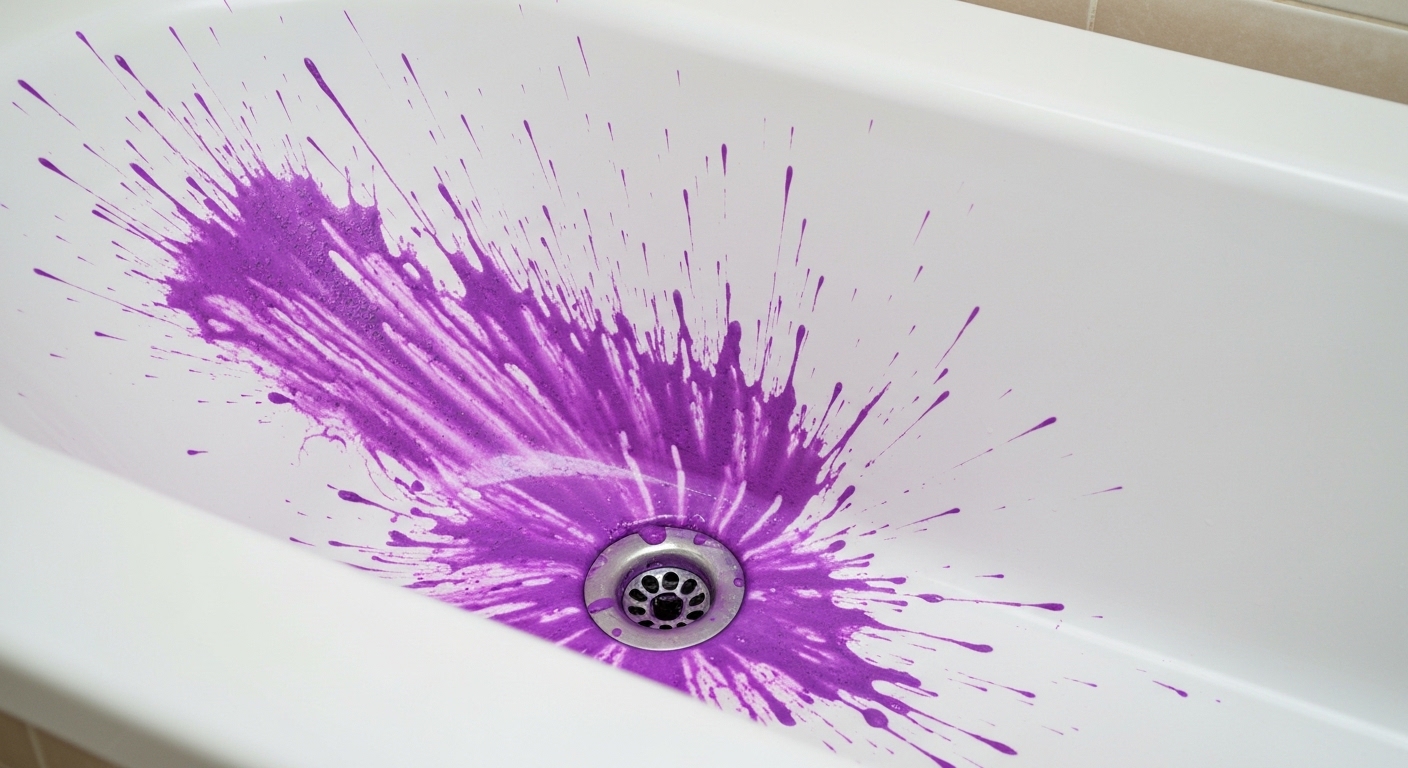
Section titled “The Dreaded Bathroom Dye Disaster”You finish a home hair coloring session, rinse the excess dye down the drain, and discover that the tub or shower surround has absorbed color that routine cleaners cannot remove. The staining often concentrates near drains, along tub walls, and on horizontal ledges where dye solution lingered.
This outcome is common because modern hair dyes are engineered to penetrate and lock color into biological fibers, and plastics share enough structural similarity to be vulnerable under the same conditions.
Porosity of Acrylic vs ABS Tubs
Section titled “Porosity of Acrylic vs ABS Tubs”The polymer chemistry of your tub determines both how deeply dye penetrates and how safely it can be removed.
Acrylic tubs are made from polymethyl methacrylate reinforced with fiberglass backing. The surface is smooth and glossy, but at a molecular level it resembles a tightly packed sponge with very small pores. Dye enters slowly, but once inside it is difficult to flush out without oxidation.
ABS plastic, acrylonitrile butadiene styrene, has a more open polymer structure. Imagine a sponge with slightly larger pores. Dye penetrates more readily and spreads laterally, which explains why ABS stains often appear darker and larger.
Fiberglass tubs rely on a polyester gel coat. When intact, this layer resists staining well. When microcracks or crazing develop, dye travels down those cracks and becomes trapped beneath the surface.
Why Hair Dye Penetrates Plastic
Section titled “Why Hair Dye Penetrates Plastic”Permanent hair dyes rely on small precursor molecules that migrate into hair, then oxidize into larger colored structures that cannot escape. When these same molecules contact plastic under alkaline, warm conditions, they diffuse into the polymer surface in a similar way.
Once oxidation occurs inside the plastic, the newly formed chromophores are physically trapped. Standard cleaners cannot reach or dissolve them, which is why stains persist even after repeated washing.
Comparison of Hair Dye Removal Methods
Section titled “Comparison of Hair Dye Removal Methods”| Method | Effectiveness | Material Safety | Typical Time | Notes |
|---|---|---|---|---|
| Hydrogen peroxide | High | Excellent on acrylic and ABS | 1 to 24 hours | Best first-line option |
| Bleach + baking soda | Moderate to high | Generally safe if monitored | 30 to 90 minutes | Mild abrasion assists oxidation |
| Solvent cleaners | Variable | Poor on acrylic | Minutes | Risk of etching or dulling |
| Abrasive scrubbing | Low long-term | Poor | Immediate | Increases future staining |
The Hydrogen Peroxide Lift Method
Section titled “The Hydrogen Peroxide Lift Method”Hydrogen peroxide works by oxidizing the dye chromophores and breaking the conjugated bonds responsible for visible color. This reverses, chemically, what the dye formation process created.
The table below outlines realistic expectations based on concentration and time.
| Peroxide Strength | 1 Hour Result | 6 Hour Result | 24 Hour Result |
|---|---|---|---|
| 3% | Lightening visible | Major fade | Often near-complete removal |
| 6% | Strong fade | Near-clear | Full removal on most stains |
| 12% | Rapid fade | Clear but higher risk | Use only on ABS with caution |
Always start with 3%. Acrylic tolerates long exposure well at this concentration, and repeated applications are safer than escalation.
Real-World Results by Tub Material
Section titled “Real-World Results by Tub Material”On acrylic tubs, peroxide treatments typically remove 70 to 95 percent of visible dye without surface dulling when patience is used, making them a common approach for dealing with issues like hair dye stains in plastic tubs. ABS tubs often show faster initial improvement but may require additional cycles due to deeper penetration. Fiberglass results vary widely and depend on gel coat condition: intact coatings respond well, while cracked coatings rarely fully clear without refinishing.
The Baking Soda and Bleach Combination
Section titled “The Baking Soda and Bleach Combination”A paste of baking soda and liquid bleach provides simultaneous oxidation and gentle mechanical action. This method is useful when peroxide alone stalls.
Keep the paste moist and limit contact to under ninety minutes. Drying increases bleach concentration and raises the risk of surface damage.
Identifying Stained vs Etched Surfaces
Section titled “Identifying Stained vs Etched Surfaces”Use this rapid decision checklist before continuing treatment.
- Does the surface still reflect light evenly when viewed at an angle.
- Is the texture smooth under a fingertip.
- Does the color look uniform rather than patchy or rainbowed.
If all answers are yes, you are dealing with staining. If not, the surface has been etched and will require polishing or refinishing after color reduction.
Safe Chemical Timelines
Section titled “Safe Chemical Timelines”Contact time controls both success and safety. Oxidizers need time to diffuse into the polymer and react, but excessive concentration or drying increases damage risk.
Hydrogen peroxide at 3% can remain on acrylic or ABS for many hours with minimal risk, though effectiveness declines as it decomposes. Refresh rather than extending a single application. Bleach-based pastes should be inspected at thirty minute intervals and rinsed no later than two hours. Solvent products should never exceed a few minutes of contact, even on ABS.
Solvent and Nail Polish Remover Risks
Section titled “Solvent and Nail Polish Remover Risks”Acetone dissolves acrylic directly and causes permanent damage within seconds, which is why using it to remove hair dye stains from plastic is risky and often counterproductive. Even acetone-free removers still contain active solvents that can extract additives or initiate stress cracking.
No solvent method is recommended for acrylic tubs. On ABS, testing in a hidden area is mandatory and contact time must be minimal.
Preventing Future Dye Stains
Section titled “Preventing Future Dye Stains”Physical barriers remain the most reliable prevention strategy. Disposable plastic liners and immediate wipe-downs prevent the diffusion window that allows staining to occur.
After successful cleaning, a thin protective sealant layer reduces polymer exposure and simplifies future maintenance.
FAQ: Hair Dye Stains in Bathtubs
Section titled “FAQ: Hair Dye Stains in Bathtubs”Can hair dye permanently stain a plastic tub? Yes, if dye precursors oxidize inside the polymer, the stain becomes chemically bound and difficult to remove without oxidizers.
Is hydrogen peroxide safe for acrylic tubs? At 3% concentration, it is one of the safest and most effective options available.
Why did scrubbing make the stain worse? Abrasion increases surface roughness, which traps pigment and accelerates future staining.
Verdict: DIY vs Professional Repair
Section titled “Verdict: DIY vs Professional Repair”DIY treatment is appropriate when stains respond progressively to oxidation and the surface remains glossy. Professional refinishing becomes the better option when etching, gel coat failure, or persistent ghosting remains after multiple chemical cycles.
Professional refinishing costs far less than fixture replacement and resolves both staining and surface degradation when prevention and cleaning are no longer sufficient.
References
Section titled “References”Society of Plastics Engineers technical data on PMMA and ABS chemical resistance. American Chemical Society publications on oxidative hair dye chemistry. Journal of Applied Polymer Science research on polymer staining mechanisms. Novus Plastic Polish manufacturer restoration documentation. Professional Refinishers Association fixture restoration standards.