Removing Tomato Sauce Stains from Plastic - Lycopene and Polypropylene Science
📑 Table of Contents
The indelible orange ring
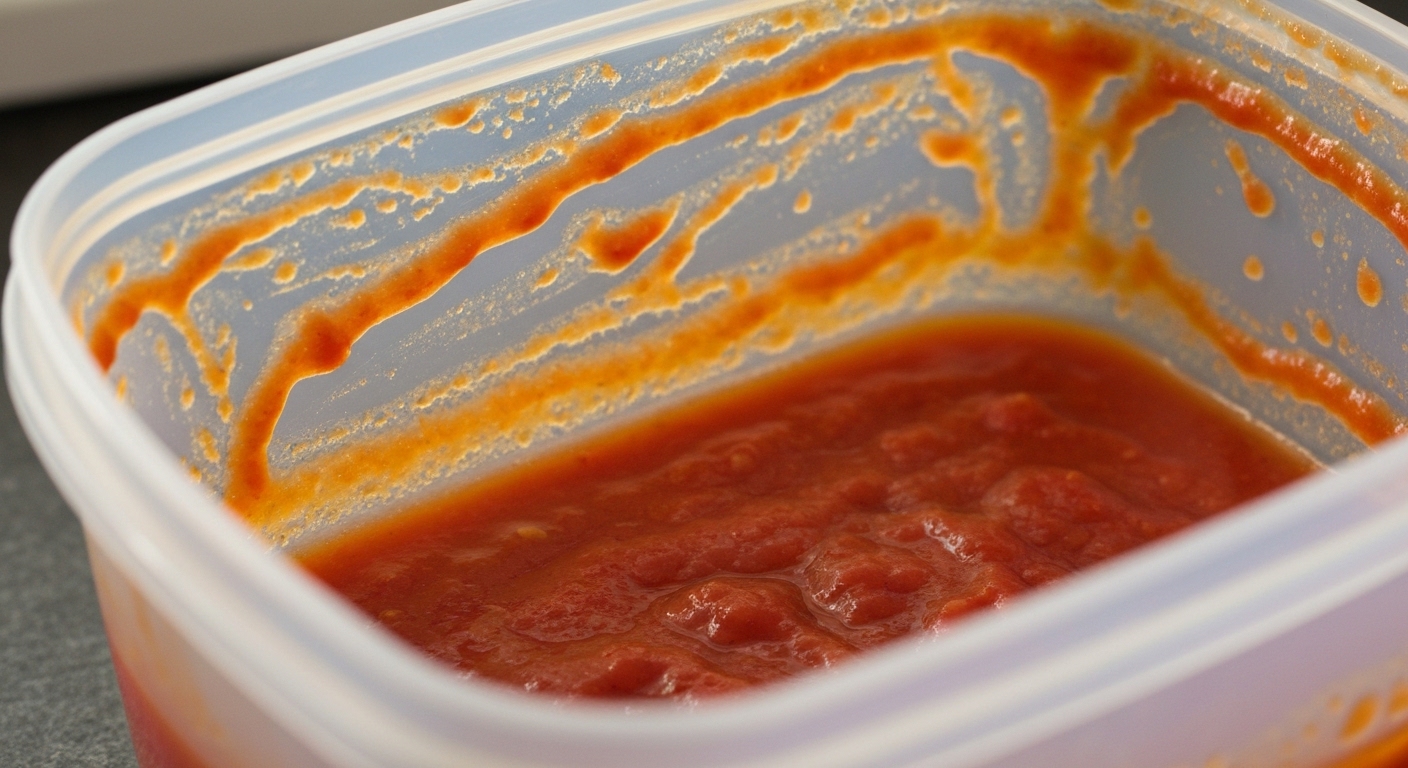
Section titled “The indelible orange ring”Tomato sauce stains plastic because the red pigment is not just sitting on the surface, it can migrate into the polymer. After storage, especially when the food was hot, the container can develop a persistent orange film or a distinct ring at the fill line that dish soap does not touch.
The effect is common across many consumer plastics, but it is most visible in semi-opaque food containers used repeatedly for reheating and leftovers.
Lycopene vs polypropylene chemistry
Section titled “Lycopene vs polypropylene chemistry”The dominant tomato pigment is lycopene, a carotenoid with an extended conjugated double-bond system that strongly absorbs visible light, producing the red-orange color. Lycopene is lipophilic, it partitions into oils and nonpolar environments, and it is poorly soluble in water.
Most reusable food storage tubs are polypropylene (recycling code 5), a nonpolar hydrocarbon polymer. That chemical similarity increases lycopene affinity for the plastic surface region, so pigment molecules can diffuse into the near-surface amorphous zones rather than remaining as a removable film.
Temperature accelerates staining because polymer chain segments become more mobile as they warm. Hot sauce and hot plastic increase diffusion rates, so storage immediately after cooking is a high-risk scenario for permanent discoloration.
Why plastic absorbs color
Section titled “Why plastic absorbs color”Solid polymers are not perfectly dense at the molecular scale. Thermal motion and the amorphous fraction create transient free volume that small organic molecules can occupy, and repeated contact shifts the equilibrium toward gradual uptake.
Oil in the food acts as a transport phase that keeps lycopene mobile and improves contact wetting on the plastic. Tomato products cooked with added oil often stain more than watery tomato preparations, even if they look similarly red.
Surface damage also increases uptake. Scratches and micro-abrasion raise surface area and provide physical trapping sites, which is why older containers typically stain faster than new ones.
Best methods that actually work
Section titled “Best methods that actually work”Stain removal succeeds when the approach either degrades lycopene chemically or pulls it back out using a compatible nonpolar phase. Dish soap alone is limited because it is primarily a water-based system designed for surface grease, not pigment diffusion out of a polymer.
- Sunlight (UV) bleaching: Wash the container, then place it in direct sun for several hours, rotating for even exposure. UV and oxygen break down the conjugated structure in lycopene into smaller, colorless oxidation products, and visible fading usually starts within the first hour.
- Oil extraction: Rub a thin layer of cooking oil onto the stain and let it sit for 30 minutes to several hours, then wash with dish soap and warm water. The oil acts as a competing reservoir for lycopene, shifting partitioning away from the polymer surface.
- Baking soda paste: Apply a paste of baking soda and water and leave it overnight, then scrub gently and rinse. This is mainly helpful for odor control and mild surface cleaning, and aggressive scrubbing can increase micro-scratching that worsens future staining.
For stubborn staining, cycle oil extraction and sunlight exposure. Oil can mobilize a fraction of pigment, and UV can destroy what remains near the surface layer.
Why hot water can make stains worse
Section titled “Why hot water can make stains worse”Hot water increases polymer segment mobility and can drive pigment deeper if lycopene is already present in the surface region. Without an effective solvent phase or oxidative pathway, heat often accelerates diffusion rather than extraction.
For prevention, a cold-water rinse immediately after emptying a tomato container reduces the time lycopene spends in contact with warm plastic. That timing matters because early uptake is fastest when the polymer is still warm from the food.
Microwave heating and pitting
Section titled “Microwave heating and pitting”Repeated microwave reheating of tomato-based foods in plastic containers can create more than discoloration, often complicating efforts like cleaning greasy food residue from plastic containers. Localized overheating at oil-rich spots can soften the surface and promote micro-pitting, stress relaxation, and texture changes.
Those defects increase effective surface area and create protected niches where pigment and residues persist. Once a container is visibly roughened or permanently hazy, staining and odor retention typically become a recurring problem.
Prevention that preserves the polymer surface
Section titled “Prevention that preserves the polymer surface”Barrier strategies work because they interrupt direct contact between lycopene-rich oil phases and the polymer. A thin pre-coat of butter or cooking oil can act as a sacrificial layer that absorbs pigment, and that layer is later removed by surfactants during washing.
The lowest-effort habit is a rapid cold-water rinse right after use, followed by normal washing later. This reduces both pigment contact time and thermal driving force for diffusion.
Glass vs plastic for tomato leftovers
Section titled “Glass vs plastic for tomato leftovers”Glass does not stain in the same way because it is an inorganic, nonporous network with no polymer free volume to accommodate pigment diffusion. Tomato residues remain on the surface and can be fully removed with routine washing.
Plastic is lighter and impact-resistant, but it accumulates surface wear and can retain pigments over time. Many households reserve glass for tomato, curry, and other pigment-heavy foods, and keep plastic for low-stain storage.
Safety of stained containers
Section titled “Safety of stained containers”A tomato stain is not, by itself, evidence of dangerous chemical degradation. Lycopene is a dietary carotenoid, and its presence in the polymer surface region is primarily an aesthetic issue.
The more realistic hygiene concern is physical. If staining is accompanied by roughness, deep scratches, or pitting, those features can shelter residues and microbes more effectively than smooth polymer, so retirement of heavily damaged containers is reasonable.
The orange ring at the fill line
Section titled “The orange ring at the fill line”The ring often forms at the sauce-air interface where evaporation and concentration effects increase pigment deposition, a dynamic frequently discussed in plastic food container stain removal and safety plastic food container stain removal and safety. That region experiences repeated wetting and drying, which can intensify uptake compared with fully submerged areas.
Targeted sunlight exposure works well for ring stains because the band can be oriented toward direct light. Reducing headspace and using tight lids also lowers evaporation-driven concentration.
High-pH cleaners and bleach, last-resort options
Section titled “High-pH cleaners and bleach, last-resort options”Strong alkaline cleaners can damage plastics by causing surface stress whitening, increased roughness, or changes in additives, especially with long contact times. If a high-pH product is used at all, it should be tested on a small area, used briefly, and rinsed extremely well.
Bleach removes color by oxidizing the conjugated bonds that produce lycopene’s chromophore. It can also oxidize polymer surfaces and can leave persistent odor in plastics, so it is best reserved for containers you would otherwise discard.
References
Section titled “References”-
Journal of Food Science. “Lycopene Stability and Migration in Food Contact Materials.” Research on pigment behavior in plastic containers.
-
Eastman Chemical Company. “Polymer Properties and Stain Resistance Guide.” Technical documentation on plastic food contact materials.
-
American Chemical Society. “Photochemical Degradation of Carotenoid Pigments.” Research on UV effects on plant pigments, which also helps explain how pigments stain plastic surfaces through light-induced chemical changes.
-
Consumer Reports. “Food Storage Container Testing and Stain Resistance.” Product testing and consumer experience data.
-
FDA Center for Food Safety. “Food Contact Material Safety Guidelines.” Regulatory framework for plastic food containers.
-
Institute of Food Technologists. “Interaction of Food Components with Packaging Materials.” Industry research on food-plastic interaction.