UV Protection Polycarbonate Greenhouse - A 10-Year PC Panel Maintenance Plan
📑 Table of Contents
Polycarbonate greenhouse panels are wonderfully tough against impact, but they are sensitive to sunlight and scratches. If you keep the surface clean, protect the UV-coated side, and stay on top of seals and fasteners, you can usually get a solid 10 to 15 years from good panels. This guide focuses on practical care that preserves light transmission and reduces waste by delaying replacement where it is genuinely safe to do so.
Why polycarbonate yellows and turns brittle
Section titled “Why polycarbonate yellows and turns brittle”Polycarbonate (PC) is naturally vulnerable to ultraviolet (UV) radiation. To make it workable outdoors, manufacturers add a thin, co-extruded UV-blocking layer on the outside face of the sheet.
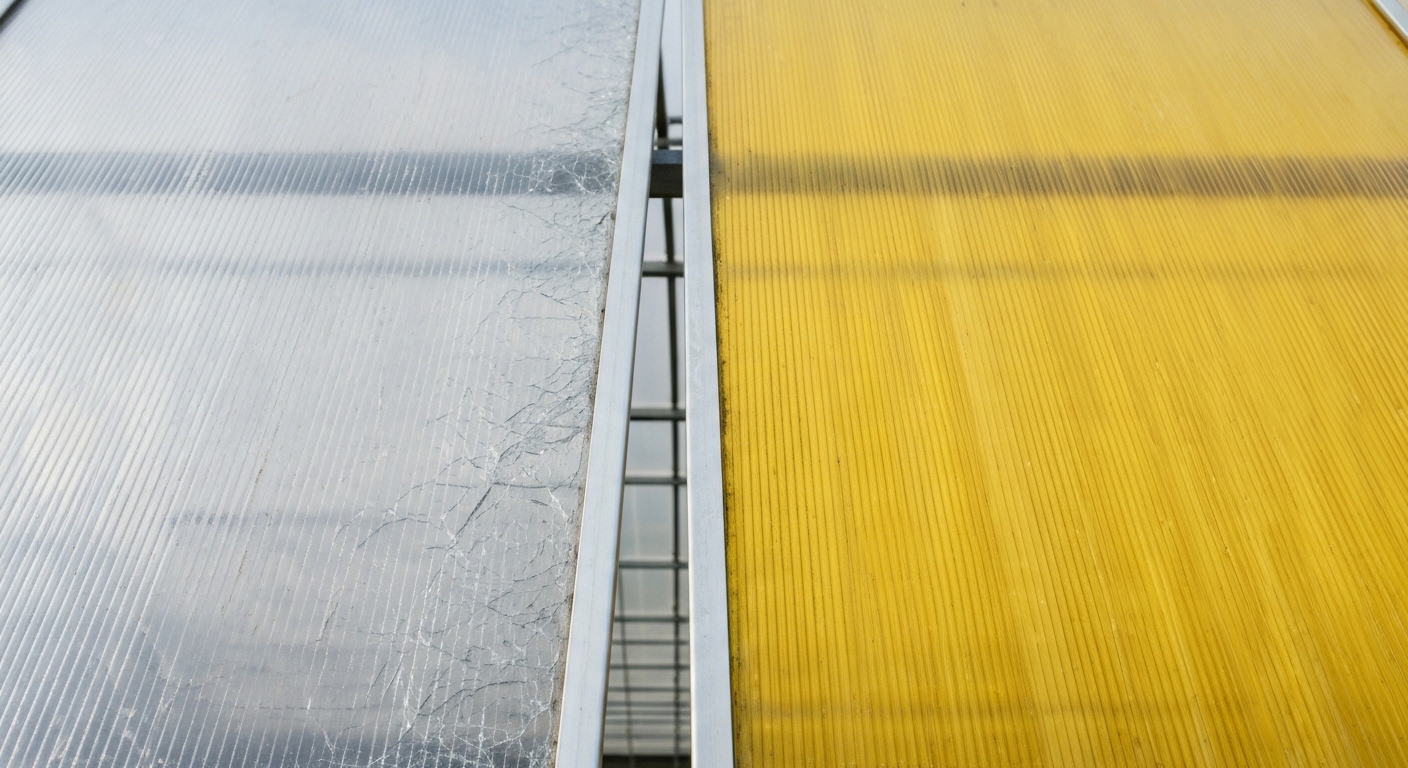
That UV layer absorbs high-energy UV photons so they do not break down the plastic underneath. Over years of sun exposure, the protective layer slowly degrades. When it is depleted (often around 10 to 15 years), UV starts attacking the polymer chains in the panel itself, a process called chain scission.
Chain scission changes the material at a molecular level. The clear panel begins to yellow, loses flexibility, and becomes brittle. At that point, the sheet can crack or shatter from minor impacts that new polycarbonate would normally shrug off.
The “UV-coated side” problem (and how to tell)
Section titled “The “UV-coated side” problem (and how to tell)”Many twin-wall panels are UV-protected on one side only. If the sheet is installed backwards, the unprotected face weathers rapidly and can fail in as little as 24 months.
During installation, the protective film usually states “THIS SIDE OUT,” but once it is removed, both faces look similar. For an existing greenhouse, you can sometimes identify the exterior face with a UV flashlight in a dark space by checking the cut edge, the treated side may fluoresce slightly differently. If that is inconclusive, look for faint edge markings or production codes that indicate which side is meant to face out.
Cleaning: skip ammonia, skip solvents
Section titled “Cleaning: skip ammonia, skip solvents”Ammonia-based glass cleaners can permanently damage polycarbonate. They can trigger stress crazing, which shows up as a fine spiderweb of micro-cracks that turn panels hazy and reduce light transmission.
Keep it simple and gentle, warm water plus a mild soap, then rinse well. Avoid pine-based cleaners and solvent-smelling products such as acetone, benzene, and strong degreasers because they can soften or etch the surface.
Why squeegees and dry wiping cause scratches
Section titled “Why squeegees and dry wiping cause scratches”Polycarbonate is impact-resistant, not abrasion-resistant. Dust, pollen, and gritty film on the roof behave like sandpaper, so dragging a squeegee or wiping dry can leave permanent scratches.
The lowest-waste approach is to prevent scratches so you are not replacing panels early. Rinse heavily with plain water first to float grit away, then wash with a microfiber mop or a soft lamb’s wool mitt, and rinse again. Avoid dry cloth-on-dry-panel wiping because static can pull grit into your wipe and grind it into the surface.
Algae inside twin-wall channels (flutes)
Section titled “Algae inside twin-wall channels (flutes)”Twin-wall panels insulate because of the internal air channels. If top or bottom sealing tape fails, moisture and spores can wick into the flutes and create green algae stripes that you cannot scrub off from the outside.
If the channels are accessible, the practical fix is to flush with an oxygen bleach solution (hydrogen peroxide or sodium percarbonate in water), let it dwell to kill growth, then flush repeatedly with clean water. If the bottom edge is sealed so water cannot escape, you may need small weep holes to drain properly. After cleaning, reseal with proper breather tape so condensation can vent while insects and spores stay out.
Condensation: anti-fog coatings and plant health
Section titled “Condensation: anti-fog coatings and plant health”On untreated plastic, condensation forms beads that can drip onto plants and reflect light. Droplets can also act like tiny lenses and create hot spots that scorch foliage on bright days.
Many greenhouse panels are sold with anti-drip or anti-fog coatings that make water sheet instead of bead. These coatings wear with time, so an interior-applied surfactant product can restore sheeting behavior and slightly improve morning light transmission during humid conditions.
UV-protectant sprays: why they rarely help on a greenhouse
Section titled “UV-protectant sprays: why they rarely help on a greenhouse”Dashboard and patio UV sprays can absorb some UV, but they are typically thin, temporary films; for guidance on longer-term polycarbonate panel care and UV protection, see polycarbonate panel care and UV protection. On a greenhouse roof, weather and washing remove most of the product quickly.
To maintain meaningful protection, you would need frequent reapplication, which is usually unrealistic for anything larger than a small cold frame. For full-size structures, the real UV protection is correct panel orientation plus replacing glazing when it has aged out.
Hail damage vs. aging (what the patterns look like)
Section titled “Hail damage vs. aging (what the patterns look like)”Hail damage is usually localized. You will see distinct circular impact marks, white stress stars, or cracks radiating from a clear center point, while surrounding areas may still look and feel healthy.
Age degradation is more uniform. Crazing, hazing, and brittleness tend to appear across broad areas, not just where impacts occurred, and older panels can shatter from relatively minor hail because they have already lost toughness.
Why “clear” panels still lose light transmission
Section titled “Why “clear” panels still lose light transmission”Even without dramatic yellowing, polycarbonate can transmit less useful plant light over time. New twin-wall panels often transmit roughly 80% to 82% of visible light, and after a decade, oxidation and micro-scratching can push that closer to 60%.
That drop matters most in winter. Plants stretch, growth slows, and you may spend more on supplemental lighting than you would on new glazing, especially if the greenhouse is used for food starts or year-round production; choosing better materials and practices that focus on preventing UV damage to outdoor plastic panels can help preserve light transmission and delay costly replacements.
Repairing cracks: use greenhouse repair tape
Section titled “Repairing cracks: use greenhouse repair tape”Standard tapes fail quickly outdoors. Duct tape breaks down in UV and leaves residue, and packing tape lifts once moisture gets underneath.
Use greenhouse repair tape made from UV-stabilized film with an aggressive acrylic adhesive (it is designed for thermal expansion and outdoor exposure). Clean the area first with isopropyl alcohol to remove wax and grime, then apply tape to both the inside and outside of the crack to stop water intrusion and slow crack growth.
Expansion and contraction: the real cause of many premature cracks
Section titled “Expansion and contraction: the real cause of many premature cracks”Polycarbonate expands and contracts a lot with temperature, far more than metal framing. A long roof sheet can change length by over half an inch between cold and hot conditions.
If fasteners are installed too tightly or holes are not oversized, panels bind and crack around screw points. Proper installation uses oversized pre-drilled holes and wide EPDM washers so the sheet can “float” under the fastener without building stress.
Sealant compatibility: why PVC and some silicones ruin polycarbonate
Section titled “Sealant compatibility: why PVC and some silicones ruin polycarbonate”Some flexible PVC products (certain tapes and gaskets) release plasticizers that can migrate into polycarbonate and soften or deform it. This is one of those slow failures that looks like “mystery melting” around edges and seams.
Also watch for acetoxy-cure silicone, it smells like vinegar as it cures and can attack polycarbonate. Use neutral-cure silicone labeled for plastics, or use EPDM rubber gaskets for long-term sealing.
Can you restore cloudy panels by polishing?
Section titled “Can you restore cloudy panels by polishing?”Headlight-restoration methods do not scale well to a greenhouse roof; the labor required is huge, and with thin greenhouse sheets, UV damage can extend deep through the material, not just the surface—issues that are better addressed by broader approaches to plastic panel restoration and UV damage prevention rather than surface-level fixes.
If the panel is broadly cloudy or opaque, replacement is usually the only realistic fix. Focus your effort on preventing the next set of panels from scratching and on keeping seals intact so twin-wall flutes stay clean.
When impact resistance is gone: safety first
Section titled “When impact resistance is gone: safety first”Aged polycarbonate can become rigid and crackly. When it loses toughness, it can fail like brittle plastic, which is a real fall and laceration risk during snow clearing or ladder work.
Each year, press firmly with your thumb in the center of a panel bay. If it feels stiff, makes crackling noises, or shows little deflection, treat the roof as a no-walk zone and keep snow loads from building up.
A practical 10-year polycarbonate panel maintenance plan
Section titled “A practical 10-year polycarbonate panel maintenance plan”Use this as a simple routine that reduces waste and keeps your growing light high without over-cleaning or harsh chemicals.
- Years 1 to 5: Wash once or twice per year with warm water and mild soap, always rinse grit off first. Reapply interior anti-fog treatment if condensation beads and drips become a problem.
- Years 5 to 10: Inspect seals, breather tape, and fastener washers, replace cracked EPDM washers and reseal edges before water reaches the flutes. Watch for early haze and scratches, they add up fast.
- Years 10+: Test annually for brittleness and monitor plant performance for signs of light loss. Budget for re-glazing when panels yellow, craze widely, or lose impact resistance.
References
Section titled “References”- Palram Americas. Polycarbonate Maintenance and Handling Guide. Manufacturer guidance on cleaning and chemical compatibility.
- University of Massachusetts Amherst. Greenhouse Glazing: Light Transmission and Aging. Extension research on plastic glazing performance.
- National Greenhouse Manufacturers Association (NGMA). Glazing standards and safety guidance for greenhouse structures.
- Sokui Chemical. Technical discussion of stress cracking and chemical interactions in polycarbonate.
- C-TEK. Installation procedures for polycarbonate, with attention to thermal expansion and fastening.