Coffee Maker Plastic Care - Descaling & Mold Prevention
📑 Table of Contents
Identify your coffee maker plastics before you choose a cleaner
Section titled “Identify your coffee maker plastics before you choose a cleaner”Clear reservoirs are commonly SAN (styrene acrylonitrile) or PMMA (acrylic), and both are prone to stress cracking if exposed to the wrong solvents. Many internal water-contact parts are PP (polypropylene) or Tritan-like copolyesters, while seals and some tubing are silicone. Some machines also use PVC tubing in non-boiling zones, and older reservoirs may be PC (polycarbonate).
If you are not sure what you have, check the molded recycling mark, a two to four letter resin code (PC, PP, SAN), or the service manual. This matters because a cleaner that is fine for PP can haze, craze, or embrittle SAN and PMMA.
For a general method to identify plastics by resin marks and behavior, use our guide on identifying household plastics.
Quick compatibility chart, what cleaners are safe on coffee maker plastics
Section titled “Quick compatibility chart, what cleaners are safe on coffee maker plastics”The table below is conservative for long-term integrity, especially for clear reservoirs.
| Cleaner | SAN (clear) | PMMA / acrylic (clear) | PC (polycarbonate) | PP (basket, tanks) | Silicone (gaskets) | PVC (some tubing) |
|---|---|---|---|---|---|---|
| White vinegar (acetic acid, dilute) | Safe, rinse well | Safe, avoid long soaks | Safe, rinse well | Safe | Safe | Generally safe, avoid long hot soaks |
| Citric acid solution | Safe | Safe | Safe | Safe | Safe, typically gentler | Generally safe |
| Bleach (sodium hypochlorite) | Avoid (crazing risk) | Avoid (crazing risk) | Avoid (environmental stress cracking) | Use only if manufacturer allows, short contact | Avoid prolonged exposure | Avoid, can accelerate aging |
| Isopropyl alcohol | Avoid (crazing risk) | Avoid (crazing risk) | Avoid frequent use | Usually safe on exterior only | Can swell some elastomers | Avoid prolonged contact |
| Dish soap (mild) | Safe | Safe | Safe | Safe | Safe | Safe |
| OxiClean, sodium percarbonate | Use cautiously, do not soak clear parts | Use cautiously, do not soak clear parts | Use cautiously | Safe for baskets, rinse fully | Usually safe short contact | Use cautiously, rinse fully |
Never mix bleach with acids (vinegar, citric acid, commercial descalers). That combination can release chlorine gas.
Scaling versus etching, why clear plastic turns cloudy
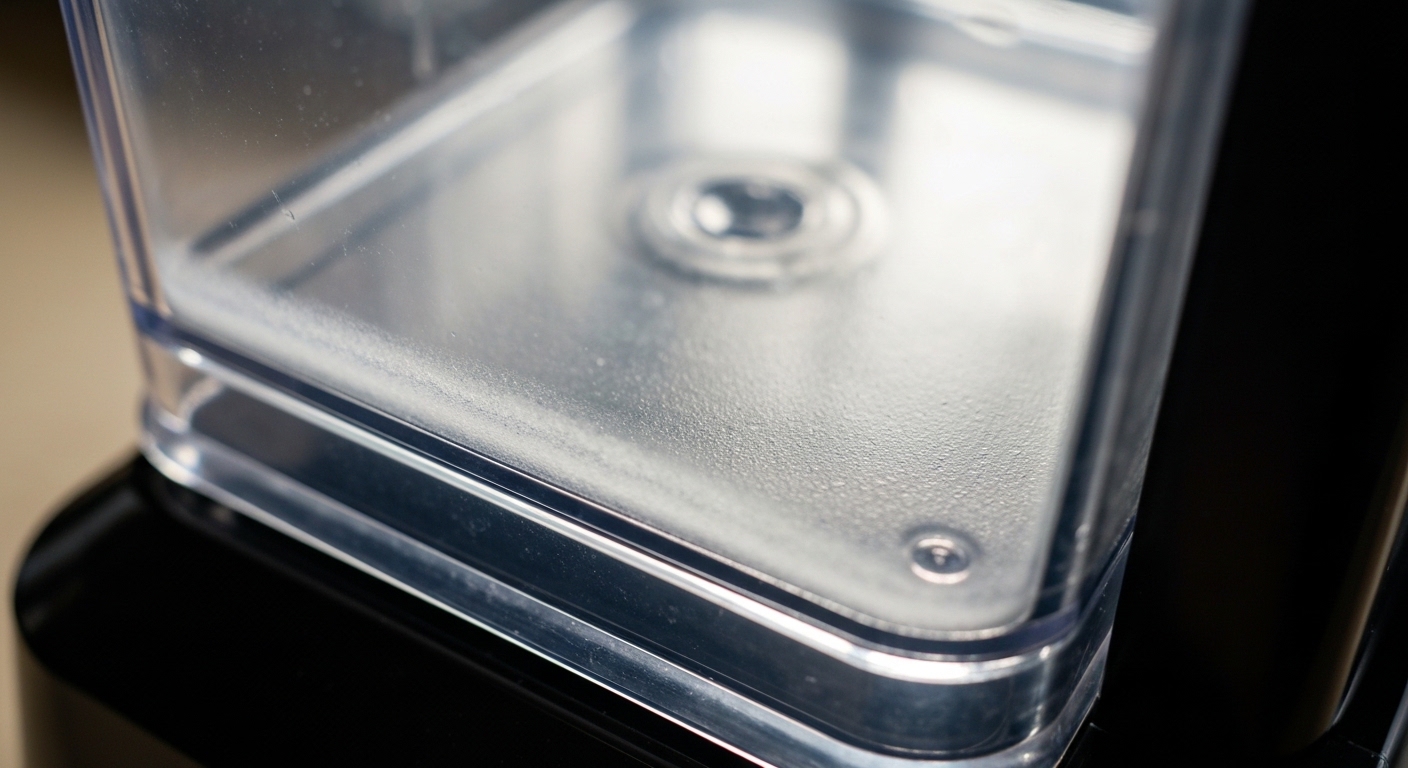
Section titled “Scaling versus etching, why clear plastic turns cloudy”“White” in a reservoir can be either removable mineral scale or permanent surface damage. Scale is usually calcium carbonate that feels slightly chalky, often wipes unevenly, and preferentially forms at waterlines and warm zones. Etching or abrasion haze is a surface roughness that scatters light uniformly and tends to feel consistently rough.
A quick diagnostic is the vinegar wipe test on a small area. If the white film dissolves or smears away after a few minutes of contact, it was scale. If there is no change and the surface stays rough or looks frosted, you are seeing etching, micro-scratches, or solvent-driven crazing.
If the reservoir is etched, stop abrasive pads and powdered cleaners on clear plastics. If you also see fine cracks, starburst patterns, or leaking seams, replacement is the safe call because crazed plastics can fail suddenly.
For the mechanics and risk of stress cracking, see plastic crazing safety guide.
Descaling chemistry, vinegar, citric acid, sulfamic, and packets
Section titled “Descaling chemistry, vinegar, citric acid, sulfamic, and packets”Most scale in coffee makers is calcium carbonate, and acids work by converting carbonate into soluble salts plus CO2, which is why the same chemistry applies when fixing a cloudy coffee maker water reservoir. The right choice depends on odor tolerance, elastomer sensitivity, and whether your machine contains aluminum in the heater or thermoblock.
Vinegar versus citric acid descaling, which is better?
Section titled “Vinegar versus citric acid descaling, which is better?”| Factor | Vinegar (acetic acid) | Citric acid |
|---|---|---|
| Odor | Strong | Low to none |
| Rinse cycles | Typically 2 to 3 | Often 1 to 2 |
| Gasket friendliness | Acceptable for most, but some brands discourage it | Often gentler on elastomers |
| Cost | Lowest | Low (powder is economical) |
| Recommended mix | 1:1 vinegar:water | 10 to 20 g/L (about 1 to 2 tbsp per liter) |
Sulfamic acid is common in some commercial descalers because it is fast and effective. It can be compatible when formulated with inhibitors, but it is still an acid with higher potency than household vinegar, so follow the manufacturer dosing exactly and do not extend dwell time.
If your unit has aluminum components, avoid leaving any acid to soak for hours. Use a warm solution, keep contact time controlled, then rinse thoroughly—similar best practices apply when descaling and caring for small plastic water reservoirs, where gentle cleaners and limited exposure help prevent damage.
Water hardness, how often to descale
Section titled “Water hardness, how often to descale”Hardness drives scale rate more than brand or usage, because calcium and magnesium concentration sets the mineral loading. Signs you are in a hard-water area include white crust on kettles, showerheads, and faucet aerators, plus a reservoir film that returns quickly after cleaning. If you want confirmation, inexpensive aquarium or pool test strips usually correlate well for household decisions.
A conservative schedule is monthly descaling if you do not know your hardness. Soft water users can often extend to every 2 to 3 months, and hard water users may need every 2 to 4 weeks.
Featured snippet, how to descale a coffee maker with vinegar
Section titled “Featured snippet, how to descale a coffee maker with vinegar”- Mix 1 part white vinegar with 1 part water (50/50) and fill the reservoir.
- Run a brew cycle until the reservoir is about half empty.
- Turn the machine off and let it soak for 30 minutes.
- Turn it back on and brew the remaining solution.
- Rinse by brewing 2 to 3 full reservoirs of water, or until the odor is gone and the first cup tastes neutral.
If your machine manual forbids vinegar, use citric acid at 10 to 20 g/L instead and follow the same half-brew plus short soak concept.
Mold and biofilm in tubing, what vinegar can and cannot do
Section titled “Mold and biofilm in tubing, what vinegar can and cannot do”Biofilm is a structured microbial layer protected by polysaccharides, and it forms readily in warm, intermittently wet systems. Vinegar can disrupt some biofilm and reduce surface pH, but it is not a guaranteed disinfectant through long internal tubing runs. Persistent musty odor, black flecks, recurring slime after cleaning, or illness concerns are replacement-level triggers because internal surfaces are not mechanically scrubbed.
Tubing is commonly silicone, sometimes PVC, and both can retain odors after microbial contamination. If a machine sat unused for months with water in it, assume biofilm matured and treat the unit as suspect unless repeated cycles fully eliminate odor and visible debris.
Dry-out routine to prevent biofilm recurrence
Section titled “Dry-out routine to prevent biofilm recurrence”After brewing, the lowest-risk habit is to remove water and increase airflow so microbes do not get a stable warm reservoir. Empty standing water when you are done for the day, leave the lid open so the reservoir can dry, and periodically remove and dry removable parts like drip trays and pod holders.
Weekly washing with hot soapy water is not optional for drip trays and reservoirs because those surfaces are continuously re-seeded with nutrients from coffee splatter and dust.
Plastic taste troubleshooting, decision tree
Section titled “Plastic taste troubleshooting, decision tree”Use this decision tree to separate new-machine odor, residue, microbial contamination, and heat damage.
Plastic taste or smell present?
Start: Is the machine new or recently unboxed?
If yes: Run 2 to 3 water-only cycles, then reassess. If the odor persists after several heat cycles, inspect for packaging residue in the reservoir and lid vents.
If no: Did you recently descale?
If yes: Suspect descaler residue. Rinse until the odor is gone, usually 1 to 3 full reservoirs, and make sure the reservoir and lid are washed with mild dish soap.
If no: Is there musty odor, slime, or visible specks?
If yes: Suspect biofilm. Clean removable parts, descale, then reassess. If odor returns quickly or black debris appears, replace because internal tubing contamination is likely.
If no: Do you see haze, fine cracks, or a frosted look in clear plastic?
If yes: Suspect crazing or etching. Stop alcohol, bleach, and abrasives. Replace the reservoir if cracked or leaking.
If no: Any scorching, warping, or burnt smell from the base? (If the item is plastic, understanding why plastic water containers turn cloudy and how to clean them can help distinguish residue buildup from actual heat damage.)
If yes: Suspect overheating plastic or electrical fault. Unplug and replace immediately.
Replace or repair, when to retire the machine
Section titled “Replace or repair, when to retire the machine”Use the checks below as a safety screen, especially for older appliances or units with persistent off-odors.
- Scorched base, melted plastic underneath, or repeated overheating smell.
- Persistent musty odor after repeated cycles, or visible black flakes in output water.
- Cracks, crazing, or leaking seams in the reservoir, especially clear SAN or PMMA.
- Reservoir likely polycarbonate (PC) and the machine is over 10 years old, and you want to reduce BPA exposure risk.
BPA in older coffee makers, how to assess risk pragmatically
Section titled “BPA in older coffee makers, how to assess risk pragmatically”Some older clear reservoirs and water spreaders used polycarbonate, often marked “PC” or a “7” resin code. Date codes are often stamped on the underside, inside a clock-style molding mark, or printed on the rating label. BPA exposure from polycarbonate is a risk-management decision, and heat, time, and repeated washing influence migration potential.
If you find PC on a unit more than a decade old, replacement is a reasonable precaution, especially if the reservoir is scratched or cloudy. For a deeper discussion of what “BPA-free” does and does not mean, see BPA Free.
Notes on specific parts
Section titled “Notes on specific parts”The filter basket is usually PP and tolerates oxygen cleaners better than clear plastics. Sodium percarbonate can strip coffee oils effectively, but do not soak aluminum parts in oxygen cleaners, and rinse thoroughly because residual alkalinity can affect taste.
Carafe lids warp from long-term heat exposure due to stress relaxation and creep, which is a polymer physics issue rather than a cleaning issue. Once warped, replacement of the lid or carafe assembly is the durable fix.
The charcoal filter holder is a common slime reservoir because it stays wet and has high surface area. Wash the holder with hot soapy water, replace the carbon element on schedule, and avoid routine bleach contact unless the manufacturer explicitly permits it for that specific part.