The Science of Non-Stick - PTFE (Teflon) Safety & Maintenance
📑 Table of Contents
PTFE safety at a glance (quick rules + temperature table)
Section titled “PTFE safety at a glance (quick rules + temperature table)”PTFE (often called Teflon) is a high performance fluoropolymer coating that is very safe in normal cooking conditions, but it has a well-defined overheating failure mode. Most real incidents come from an empty pan left on high heat, broiler exposure, or a dry pan on induction that ramps faster than expected.
PTFE Safety Rules (checklist)
- Do keep the burner at low to medium for most cooking, and preheat briefly only with oil or food present.
- Do use a hood fan or open a window if you accidentally see smoke.
- Do use wood, silicone, or nylon tools to protect the topcoat.
- Do hand wash with a soft sponge, and cool the pan before washing to avoid warping.
- Don’t preheat an empty nonstick pan on high, especially on induction.
- Don’t use the broiler or very high oven temperatures unless the manufacturer explicitly rates the pan and handle for it.
- Don’t keep using a pan that is peeling, heavily pitted, greyed out from overheating, or failing the egg test.
| Pan surface temperature | Practical meaning | What to do |
|---|---|---|
| ≤ 500°F (260°C) | Typical safe operating range for PTFE cookware in normal use | Cook normally, avoid dry preheats and keep ventilation reasonable |
| 500 to 660°F (260 to 350°C) | Increasing risk of thermal degradation, especially if the pan is empty or smoking | Reduce heat immediately, add food or liquid if appropriate, ventilate |
| ≥ 660°F (≥ 350°C) | Rapid decomposition becomes more plausible, fume risk rises, bird hazard becomes severe | Turn off heat, ventilate, leave the area, follow the overheating steps below |
Temperature thresholds vary by formulation, coating thickness, and how the temperature is measured (air vs metal vs coating). For the underlying chemistry and decomposition products, see reviews of PTFE thermal degradation behavior in the materials and occupational literature.
Sources: FDA information on PFAS in food contact materials and general safety position statements on fluoropolymers, and peer-reviewed reviews on PTFE pyrolysis products and temperature dependence.
References: FDA (Food Contact Substances) pages, and review literature in Chemosphere and related journals on PTFE thermal degradation.
What is PTFE (Teflon), and why is it so non-stick?
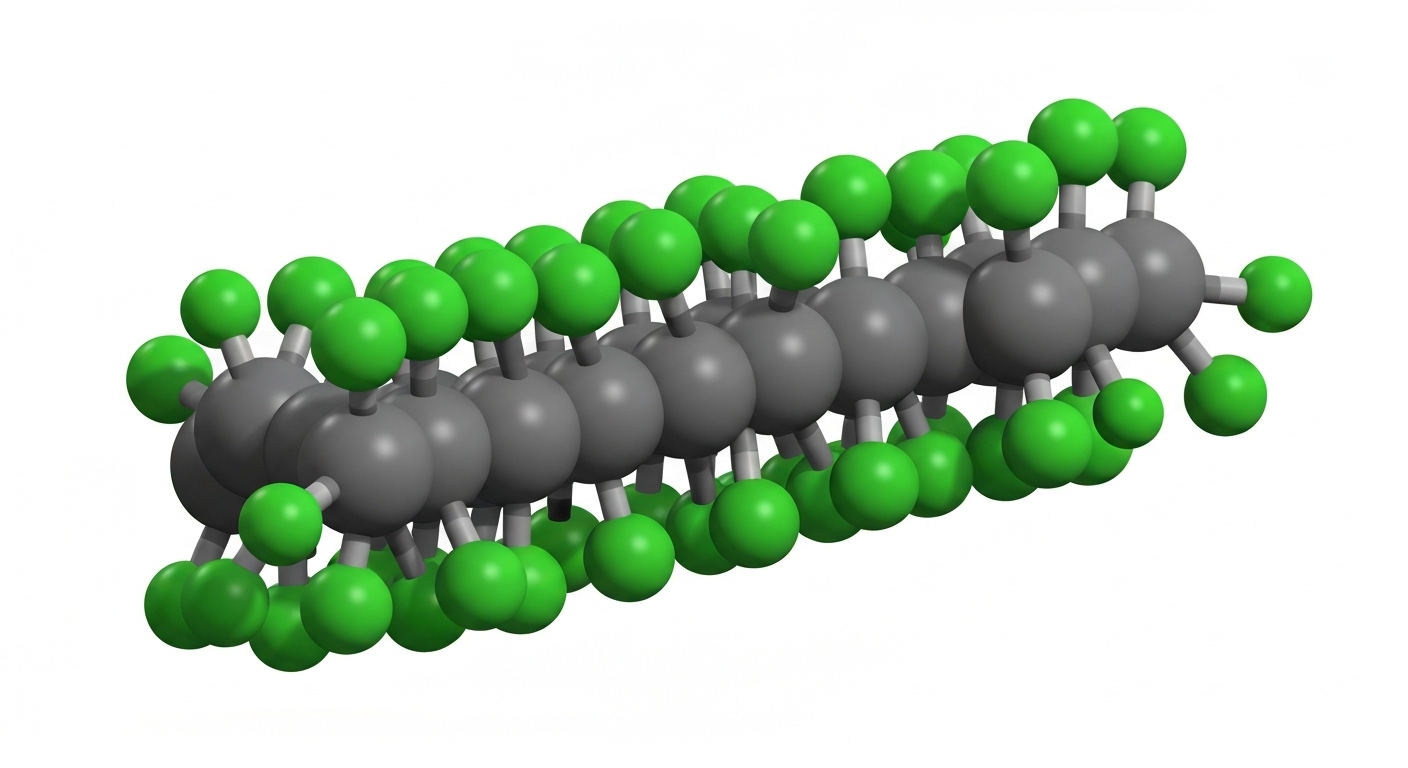
Section titled “What is PTFE (Teflon), and why is it so non-stick?”Polytetrafluoroethylene (PTFE) is a synthetic fluoropolymer discovered in 1938 (Plunkett, DuPont). Its non-stick behavior comes from a carbon backbone that is fully shielded by fluorine atoms, creating an exceptionally low surface energy and very weak intermolecular attraction.
The carbon to fluorine bond is among the strongest single bonds in organic chemistry, which is why intact PTFE is chemically resistant and does not readily react with water, oils, or most kitchen chemicals. That same “does not want to bond” property is why eggs release so cleanly when the coating is intact.
In cookware, PTFE is not just painted onto metal. Manufacturers roughen (often grit blast) aluminum or steel, then use a primer and binder system (commonly polyamide-imide or related resins) to mechanically anchor the fluoropolymer topcoat.
The PFOA vs GenX history (what “PFOA-free” does and doesn’t mean)
Section titled “The PFOA vs GenX history (what “PFOA-free” does and doesn’t mean)”The biggest public health controversy around legacy nonstick was not the PTFE polymer itself, but older manufacturing chemistry. Historically, PFOA (C8) was used as a processing aid (a surfactant/emulsifier) during PTFE manufacture, not as the finished coating.
“Processing aid” matters because it frames where risk could occur. Occupational exposure and environmental releases near production sites drove many of the strongest epidemiology signals, while finished cookware generally had much lower levels, especially after reforms and phase-outs.
Under the US EPA 2010/2015 Stewardship Program, major manufacturers committed to reducing and largely eliminating PFOA-related emissions and product content. By the mid-2010s, mainstream consumer nonstick in the US and EU market shifted to “PFOA-free” formulations.
Reference: US EPA PFOA Stewardship Program documentation.
What replaced PFOA (GenX and other short-chain PFAS)
Section titled “What replaced PFOA (GenX and other short-chain PFAS)”Many facilities transitioned to alternative processing aids, including GenX (a trade name often used for HFPO-DA and related substances) and other shorter-chain PFAS. Shorter-chain PFAS often show shorter biological half-lives than PFOA, but “shorter half-life” is not equivalent to “safe.”
Toxicology and exposure science for these replacements is still developing, and regulatory positions continue to evolve. The US EPA, for example, has issued health-based guidance and risk management actions for several PFAS including GenX-related compounds, reflecting ongoing concern about persistence and potential health effects at sufficient exposure.
References: US EPA PFAS pages, including GenX/HFPO-DA assessments and drinking water health advisories.
What “PFOA-free” means on a pan label
Section titled “What “PFOA-free” means on a pan label”“PFOA-free” typically means PFOA is not intentionally used in manufacture and is controlled to very low residual levels. It does not mean the product is “PFAS-free,” because PTFE itself is a PFAS polymer by many definitions, and some supply chains may use other PFAS processing aids.
If your decision goal is “avoid PFAS chemistry entirely,” PTFE cookware is not the category that satisfies that requirement. If your goal is “avoid legacy PFOA,” most reputable modern PTFE cookware meets that expectation.
At what temperature does Teflon become unsafe (and what “off-gassing” actually is)
Section titled “At what temperature does Teflon become unsafe (and what “off-gassing” actually is)”People often say PTFE “off-gasses,” but there are two distinct phenomena. At moderate temperatures, you can have normal volatilization of trace residues from oils or food, while the coating remains intact. At higher temperatures, PTFE begins thermal decomposition (pyrolysis), which can generate ultrafine particles and gaseous fluorinated fragments.
Peer-reviewed thermal degradation studies show PTFE decomposition accelerates as temperatures move into the mid-hundreds Celsius, with different byproducts appearing as temperature increases. Consumer guidance commonly places practical “avoid overheating” limits around the mid-500°F range, because empty-pan scenarios can overshoot quickly and reach temperatures where decomposition becomes more plausible.
References: Reviews and experimental papers on PTFE thermal degradation and emitted products (often summarized in Chemosphere and occupational hygiene literature).
How overheating happens in real kitchens
Section titled “How overheating happens in real kitchens”An empty nonstick pan is the dominant risk amplifier because there is no thermal mass (water in food, oils, sauces) to stabilize the surface temperature. A thin aluminum pan on a high-output burner can rise from warm to extreme temperatures in minutes, and induction can ramp especially fast if the pan is left dry.
Broilers are another common failure mode. Radiant broiler elements can heat a pan edge and rim above what the stovetop setting would suggest, and some handles and binders are not designed for those thermal gradients, a risk that also helps explain why PTFE non-stick cookware requires nylon or silicone utensils to avoid damage under high, uneven heat.
Oven use is manufacturer-specific. Many “oven safe” ratings are limited by the handle material and the coating system’s binder package, not by PTFE alone.
PTFE fumes and polymer fume fever (humans)
Section titled “PTFE fumes and polymer fume fever (humans)”When PTFE is significantly overheated, emissions can irritate the respiratory tract and, in some exposures, produce polymer fume fever. This is a recognized occupational-style syndrome characterized by flu-like symptoms after inhalation of thermal decomposition products from fluoropolymers.
Symptoms and timeline
Section titled “Symptoms and timeline”Commonly reported symptoms include fever, chills, malaise, headache, chest tightness, and dry cough. Onset is often delayed by several hours after exposure (frequently cited around 4 to 8 hours), and many cases resolve within 24 to 48 hours with supportive care.
Most of the strongest documentation comes from workplace case reports and exposure investigations rather than controlled trials, for obvious ethical reasons. Severity depends on temperature, duration, ventilation, and individual susceptibility.
Reference: occupational medicine and industrial hygiene literature on polymer fume fever.
Long-term lung harm, what is known and what is not
Section titled “Long-term lung harm, what is known and what is not”Acute polymer fume fever is typically described as self-limited in the medical literature, but repeated or severe inhalation of combustion and pyrolysis products is not a respiratory health strategy. Claims that a single home exposure “causes permanent fibrosis” are often overstated for typical household events, and the better-supported message is risk reduction: avoid overheating, ventilate promptly, and treat significant symptoms seriously.
If you have asthma, COPD, or other lung disease, treat exposure more conservatively and seek medical advice sooner. If symptoms are severe or worsening, do not self-diagnose.
When to call a doctor or seek urgent care
Section titled “When to call a doctor or seek urgent care”Seek urgent medical evaluation if you have shortness of breath at rest, persistent wheezing, blue lips or face, confusion, fainting, coughing up blood, or chest pain that is not clearly muscular. Call a clinician if fever and cough persist beyond 48 hours, if you have significant underlying lung disease, or if multiple household members become symptomatic after a fume event.
PTFE fumes and birds (why birds are uniquely high risk)
Section titled “PTFE fumes and birds (why birds are uniquely high risk)”Birds have a highly efficient respiratory system with rapid gas exchange, which also makes them more vulnerable to airborne toxins. Overheated PTFE has been associated with acute avian toxicity events, sometimes rapidly fatal.
If you keep parrots, budgies, cockatiels, finches, or other pet birds, treat PTFE cookware as a high-consequence material. Many avian veterinarians recommend avoiding PTFE in the home entirely because a single overheating mistake can be catastrophic.
What to do if you overheated a nonstick pan
Section titled “What to do if you overheated a nonstick pan”Turn off the burner immediately and, if it is safe, move the pan off the hot element to stop temperature rise. Increase ventilation fast by turning on the hood at maximum and opening windows, and leave the kitchen while the air clears.
Avoid leaning over the pan to “check the smoke.” Ultrafine particles and irritant gases concentrate in the hot plume above the cookware.
If you have birds, remove them from the home airspace as quickly as possible, ideally to an outdoor carrier or a sealed room with separate ventilation, and call an avian veterinarian for guidance. Do not assume that “no smell” means “no hazard” for birds.
Symptom monitoring (practical timeline)
Section titled “Symptom monitoring (practical timeline)”If exposure occurred, monitor for headache, cough, chest tightness, fever, or chills over the next several hours. Many polymer fume fever cases, when they occur, present later the same evening rather than immediately.
Hydrate, rest, and avoid additional respiratory irritants (smoke, aerosols). Seek medical care using the thresholds listed above, and tell the clinician it was a fluoropolymer fume exposure from overheated nonstick cookware.
Is a scratched Teflon pan safe, and when should you replace it?
Section titled “Is a scratched Teflon pan safe, and when should you replace it?”A scratch is usually a performance and durability failure before it is an acute poisoning emergency. Solid PTFE is largely chemically inert in the gastrointestinal tract and is unlikely to be absorbed if a small flake is swallowed.
The bigger concerns are mechanical and hygiene related. Scratches create stress concentrators that grow under repeated heating and utensil abrasion, and they can expose lower layers (primer, binder) or the metal substrate.
Cosmetic scratches vs replacement-worthy damage
Section titled “Cosmetic scratches vs replacement-worthy damage”Hairline marks that do not catch a fingernail and do not show base metal are often cosmetic, especially on textured coatings, and concerns here are typically lower than broader debates like PTFE non-stick safety versus plastic leaching under heat and fat. Deep grooves, widespread pitting, peeling edges, or any area where you can see bare metal are replacement signals.
If the pan is shedding visible flakes, has raised edges you can feel, or the coating is delaminating near the rim, replace it. Those failure modes are where food and oil can lodge, carbonize, and create persistent sticking and off-odors.
Microplastics and what “inert” does and doesn’t cover
Section titled “Microplastics and what “inert” does and doesn’t cover”While PTFE is chemically stable, abrasion can generate particles. The health science on dietary microplastics is still evolving, and risk framing should be proportional, but minimizing avoidable particle ingestion is reasonable.
For broader context on household shedding pathways, see microplastics. For chemical migration concepts across common polymers, see dishwasher safe.
Why nonstick “stops working,” and how to fix it without destroying the coating
Section titled “Why nonstick “stops working,” and how to fix it without destroying the coating”Most early “my pan is dead” complaints are not true PTFE loss. They are carbonized oil films and polymerized residues that create a sticky, higher surface energy layer on top of the coating.
Butter and some unrefined oils have relatively low smoke points, so medium-high heat can burn residues onto the surface. Each cycle of overheating fats adds more varnish, and aggressive scrubbing then damages the topcoat.
Cleaning rules that preserve the coating
Section titled “Cleaning rules that preserve the coating”PTFE is comparatively soft, so abrasive pads can micro-scratch the surface and accelerate failure; for broader context on materials choices, see how PTFE (Teflon) non-stick coatings compare to silicone safety. Also avoid thermal shock, because aluminum expands and contracts faster than the coating stack, which can promote warping and delamination.
Baking soda paste (for brown, sticky buildup)
Section titled “Baking soda paste (for brown, sticky buildup)”Baking soda can remove carbonized films with less coating damage than harsh abrasives when used correctly. Make a paste, apply to the affected area, let it dwell briefly while still wet, then scrub gently with a soft sponge and rinse well.
This works by mild abrasion plus alkaline cleaning that helps lift oxidized oils. If the underlying coating is already worn through, no cleaning protocol can restore true nonstick behavior.
Dishwasher use: is “dishwasher-safe” nonstick a myth?
Section titled “Dishwasher use: is “dishwasher-safe” nonstick a myth?”Dishwashers combine high pH detergents, oxidizers, and mechanical abrasion from spray and contact with other items. Even when a manufacturer claims “dishwasher safe,” repeated cycles can accelerate edge corrosion, degrade binder layers, and dull the surface.
For the polymer and detergent chemistry, see Dishwasher Safe. For longest service life, hand washing with mild detergent and a soft sponge is the most conservative approach.
PTFE vs ceramic vs stainless or cast iron, which pan for which job?
Section titled “PTFE vs ceramic vs stainless or cast iron, which pan for which job?”No single material wins every use case, because the failure modes differ. PTFE excels at low to moderate heat release cooking, ceramic coatings tolerate higher temperatures but lose nonstick performance faster for many users, and stainless or cast iron handle searing and high-heat better with correct technique.
Ceramic “nonstick” is typically a sol-gel silica-based coating that forms a glassy surface. It can be PFAS-free depending on the product, but “ceramic” is not a regulated guarantee, so brand transparency and third-party disclosures matter.
Stainless steel, cast iron, and carbon steel are not coatings in the same sense. They demand technique (preheat control, oil management) but can last decades and tolerate very high temperatures.
Use-case matrix (what I recommend in practice)
Section titled “Use-case matrix (what I recommend in practice)”| Job or household constraint | Best default choice | Why |
|---|---|---|
| Eggs, delicate fish, pancakes at low to medium heat | PTFE | Lowest friction, easiest release with minimal fat |
| High-heat searing, blackening, wok-style high heat | Cast iron / carbon steel / stainless | No coating to pyrolyze, better thermal robustness |
| Bird owners or anyone who cannot tolerate overheating risk | Stainless / cast iron / carbon steel | Eliminates PTFE fume hazard from kitchen mistakes |
| “I want a PFAS-avoiding coating-style pan” | Ceramic (sol-gel), accept shorter lifespan | Higher temperature tolerance, but nonstick often degrades sooner |
| Acidic sauces for long simmers | Stainless or enameled cast iron | Better resistance to long dwell times and utensil stirring |
| Dishwasher households that will not hand wash | Stainless | Coatings usually die early in dishwashers |
Expected lifespan and care differences (decision-based)
Section titled “Expected lifespan and care differences (decision-based)”PTFE pans often last longer than ceramic in real kitchens when heat is controlled and utensils are gentle, because PTFE remains lubricious even with minor wear. Ceramic coatings can feel excellent when new, but brittleness and surface roughening often lead to sudden sticking, especially after repeated high heat, abrasive cleaning, or dishwasher cycles.
If you want a single “easy egg pan,” buy PTFE and treat it as a consumable tool with strict heat discipline. If your priority is high-heat versatility or bird safety, skip coated pans and learn stainless or seasoned iron.
When to discard a PTFE pan (a practical lifecycle test)
Section titled “When to discard a PTFE pan (a practical lifecycle test)”Nonstick cookware should be treated as a wear item. Replace the pan if you see peeling or flaking, if the coating is lifting at the rim, if the surface has turned grey or chalky from overheating, or if the pan is warped and creates hot spots.
A simple performance check is the egg test. If a lightly oiled egg sticks consistently on a properly heated pan, either the surface is fouled with residue you cannot remove or the coating has worn through.
Disposal is region-specific. Many municipal recycling streams reject coated cookware because the coating contaminates metal recycling, so check your local program.
FAQ: scratches, microplastics, PFOA-free labels, and air fryers
Section titled “FAQ: scratches, microplastics, PFOA-free labels, and air fryers”At what temperature does Teflon become unsafe?
Section titled “At what temperature does Teflon become unsafe?”For practical home cooking, keep PTFE surfaces at or below about 500°F (260°C), and avoid empty-pan heating that can rapidly overshoot. Above roughly 500 to 660°F (260 to 350°C), thermal degradation becomes more plausible and fume risk rises, especially if you see smoke. At ≥ 660°F (≥ 350°C), decomposition accelerates and the event should be treated as a fume exposure with ventilation and leaving the area.
References: thermal degradation reviews of PTFE emissions behavior and temperature dependence, and FDA context on fluoropolymers in food-contact uses.
Are PTFE fumes toxic?
Section titled “Are PTFE fumes toxic?”When PTFE is overheated into decomposition temperatures, emitted ultrafine particles and gases can irritate lungs and can cause polymer fume fever in some exposures. In normal cooking temperature ranges, PTFE is generally stable, so the main safety variable is overheating.
Is a scratched nonstick pan toxic?
Section titled “Is a scratched nonstick pan toxic?”A scratch is usually not an acute poisoning risk because intact PTFE is largely inert if swallowed. Deep scratches and peeling are still replacement-worthy because they expose lower layers, trap residues, shed particles, and fail sanitation.
What if I ate black flakes from a nonstick pan?
Section titled “What if I ate black flakes from a nonstick pan?”Small flakes are unlikely to be absorbed because PTFE is chemically resistant and passes through the gut. If the pan is flaking, replace it because ongoing shedding and hygiene problems are the real issue.
Does “PFOA-free” mean nonstick is safe?
Section titled “Does “PFOA-free” mean nonstick is safe?”“PFOA-free” addresses one legacy processing aid and is meaningful historically, but it does not mean PFAS-free. PTFE itself is a fluoropolymer, and some manufacturing chains use other PFAS processing aids, so the label is not a blanket guarantee.
Is PTFE safe around pet birds?
Section titled “Is PTFE safe around pet birds?”Birds are unusually sensitive to fumes from overheated fluoropolymers, and incidents have been reported after kitchen overheating events. The most conservative guidance for bird owners is to avoid PTFE cookware and other PTFE-heated appliances.
Can you put a PTFE pan in the dishwasher?
Section titled “Can you put a PTFE pan in the dishwasher?”Many products claim dishwasher-safe, but repeated dishwasher cycles commonly shorten coating life due to alkaline detergents, oxidizers, heat, and abrasion. Hand washing is the lowest-wear method, and it is typically the difference between a short-lived pan and a multi-year pan.
Can you use PTFE cookware in the oven or under a broiler?
Section titled “Can you use PTFE cookware in the oven or under a broiler?”Oven safety depends on the full system, including the handle, rivets, and binder layers, not only the PTFE topcoat. Broilers are high risk because radiant heating can spike surface temperatures beyond safe limits, so follow the manufacturer rating and avoid broiler exposure unless explicitly allowed.
Are air fryers a PTFE risk?
Section titled “Are air fryers a PTFE risk?”Some air fryer baskets use PTFE or other coatings, and air fryers can reach high setpoints with intense airflow. Follow the appliance’s maximum temperature rating, avoid running it empty, and replace baskets with peeling or damaged coatings.
References
Section titled “References”- US EPA. PFOA Stewardship Program (2010/2015) documentation and PFAS regulatory pages (including GenX/HFPO-DA materials). https://www.epa.gov/
- US FDA. Food contact substance information and PFAS context for food contact materials. https://www.fda.gov/
- Peer-reviewed review literature on PTFE thermal degradation chemistry and emitted products (commonly indexed under fluoropolymer pyrolysis and PTFE decomposition in journals such as Chemosphere).
- Occupational medicine and industrial hygiene literature on polymer fume fever case reports and diagnostics.
- Consumer durability testing perspectives for coated cookware performance (e.g., Consumer Reports). https://www.consumerreports.org/
- Avian veterinary and toxicology reports describing sensitivity to overheated fluoropolymer fumes (case-based evidence, severity-dependent).