Cloudy Plastic Shower Caddy Cleaning - Mineral Scale and Soap Scum Removal
📑 Table of Contents
The Opaque Organizer Problem
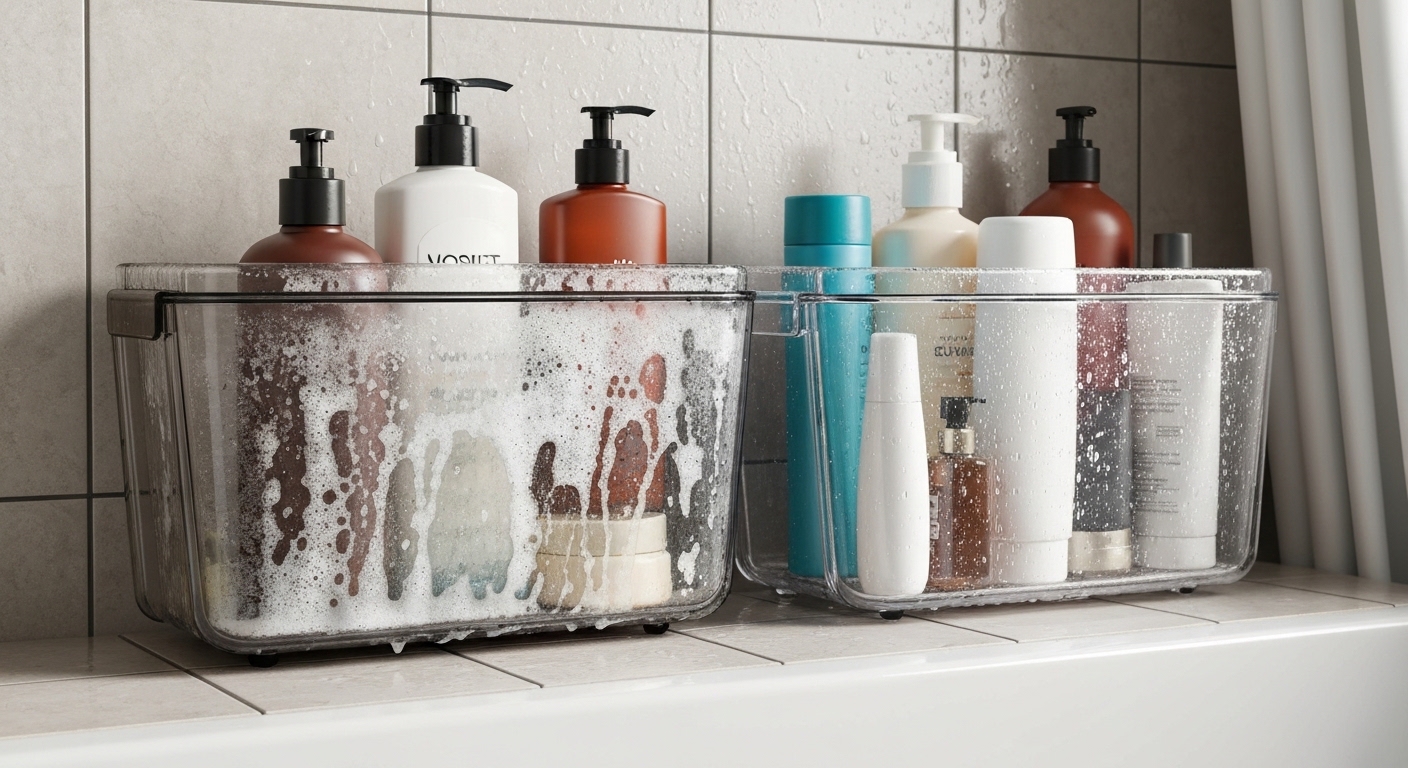
Section titled “The Opaque Organizer Problem”A clear plastic shower caddy often turns cloudy after months of exposure to hard water, soap, and constant humidity. The haze is not simple dirt but a combination of mineral scale, soap-derived residues, and in some cases irreversible plastic degradation.
Shower environments are uniquely aggressive for polymers because they combine heat, moisture, surfactants, and dissolved minerals, all of which accelerate degradation in different ways. Understanding which mechanism is responsible—such as why plastic becomes cloudy from mineral scale and residue—determines whether cleaning will restore clarity or whether replacement is the only safe option.
Quick Diagnosis: What Kind of Cloudiness Is This?
Section titled “Quick Diagnosis: What Kind of Cloudiness Is This?”This decision process identifies the cause in under a minute using touch, appearance, and a simple chemical response.
If the surface feels waxy or slightly greasy when rubbed with a finger, the cloudiness is dominated by soap scum. If it feels hard or gritty and resists fingernail scraping, mineral scale is the primary contributor.
Apply a drop of white vinegar to a small area. Bubbling or visible clearing indicates calcium carbonate scale reacting with acid, while no change suggests soap scum or surface damage.
If neither acidic nor alkaline cleaning changes the appearance, and the haze appears to extend through the plastic thickness, the issue is internal clouding or stress damage rather than removable deposits.
How to Clean a Cloudy Plastic Shower Caddy (5 Steps)
Section titled “How to Clean a Cloudy Plastic Shower Caddy (5 Steps)”- Rinse thoroughly to remove loose debris and wet all deposits evenly.
- Wash with warm water and dish soap to remove organic soap scum components.
- Apply an acidic treatment such as vinegar or citric acid for mineral scale.
- Rinse and evaluate, then polish lightly if surface dullness remains.
- Apply a water-repellent coating to slow future buildup.
Soap Scum vs Mineral Scale
Section titled “Soap Scum vs Mineral Scale”Soap scum forms when sodium or potassium fatty acid salts from soap react with calcium or magnesium ions in hard water, converting soluble soap into insoluble calcium stearate that adheres strongly to plastic surfaces as a waxy film, which is why understanding the chemistry behind the residue is useful when it comes to cleaning plastic soap dishes and soap scum buildup.
Mineral scale forms when dissolved calcium bicarbonate decomposes during evaporation, releasing carbon dioxide and depositing calcium carbonate crystals. These deposits are hard, opaque, and chemically alkaline.
A simple home test distinguishes them. Alkaline cleaners soften soap scum but do little to scale, while acids dissolve scale rapidly and only slowly affect soap residues.
Many caddies show layered contamination where soap scum traps mineral crystals, which is why sequential alkaline then acidic cleaning is chemically necessary rather than redundant.
Polystyrene vs Acrylic Caddies
Section titled “Polystyrene vs Acrylic Caddies”Most clear shower caddies are made from polystyrene or acrylic, each with different chemical tolerances. Polystyrene, recycling code 6, is economical but prone to internal crazing and solvent sensitivity.
Acrylic, also known as polymethyl methacrylate, offers better optical clarity but is vulnerable to alcohols and ammonia, which can induce stress cracking. Guidance for acrylic-safe cleaning parallels that used for acrylic vanity organizers, although shower exposure is chemically harsher.
Neither material tolerates aggressive abrasion. Scratching increases surface area and accelerates future deposit adhesion.
Cleaning Product Comparison: Vinegar vs Citric Acid vs Commercial Descalers
Section titled “Cleaning Product Comparison: Vinegar vs Citric Acid vs Commercial Descalers”| Cleaner Type | Effectiveness on Scale | Plastic Safety | Odor | Typical Cost |
|---|---|---|---|---|
| White Vinegar (Acetic Acid ~5%) | Moderate | High for acrylic and polystyrene | Strong, dissipates quickly | Low |
| Citric Acid Solution | High | High when diluted | Mild | Low to moderate |
| Commercial Descalers (Phosphoric or HCl based) | Very high | Variable, test required | Moderate to strong | Moderate |
Citric acid is often the best balance for showers because it chelates calcium efficiently without the volatility or polymer risk of stronger mineral acids.
Method: The Dishwasher Treatment
Section titled “Method: The Dishwasher Treatment”Dishwasher cleaning works by combining heat, mechanical action, and alkaline detergent chemistry. Typical wash temperatures range from 55 to 70 °C, which softens soap scum and activates detergent builders such as sodium carbonate.
Place the caddy on the top rack only and disable heated drying if possible. Avoid this method entirely for thin polystyrene or items under mechanical stress, as heat accelerates creep deformation.
This method removes organic residues effectively but does not dissolve calcium carbonate. Remaining haze after a dishwasher cycle almost always indicates mineral scale or material damage.
Buffing Out Dull Spots
Section titled “Buffing Out Dull Spots”Surface dullness from micro-scratching can be improved with plastic polish. Fine polishing compounds are roughly equivalent to 3000 to 5000 grit sandpaper, while heavier restorers approach 1500 to 2000 grit.
On thin acrylic walls, material removal must stay below a few micrometers to avoid optical distortion. Polystyrene tolerates even less removal before clarity loss becomes permanent.
If polishing improves clarity briefly but haze returns when wet, the cloudiness is internal and cannot be corrected mechanically.
Removing Pink Mold from Joints
Section titled “Removing Pink Mold from Joints”Pink residue in corners is bacterial growth, most commonly Serratia marcescens. It feeds on soap residues rather than the plastic itself, similar to contamination seen in humidifier water tanks.
Bleach-based or quaternary ammonium cleaners kill the bacteria effectively when given sufficient contact time. Rinsing afterward is essential to prevent polymer surface oxidation.
Reducing soap residue and allowing complete drying between showers is more effective than repeated disinfection.
When Cleaning Won’t Work: Replace vs Restore
Section titled “When Cleaning Won’t Work: Replace vs Restore”Cleaning cannot reverse internal polymer changes such as hydrolytic degradation, UV-induced oxidation, or solvent stress cracking. These appear as uniform haze, fine internal lines, or brittleness.
If cloudiness remains unchanged after alkaline washing, acidic descaling, and light polishing, replacement is the only option. Continued use of degraded plastics risks structural failure under load.
Replacement is also advised when stress cracks appear near mounting points, as failure can occur suddenly and without warning, even with routine maintenance like removing soap scum from plastic shower accessories.
High-Humidity Polymer Care
Section titled “High-Humidity Polymer Care”Shower humidity accelerates water diffusion into polymers, which slowly reduces molecular weight in susceptible plastics. This process is irreversible and cumulative.
Periodic drying, good drainage, and minimizing standing water slow degradation significantly. These measures are more effective than any coating once internal damage begins.
Guidance here differs from items like dish racks, which experience alkaline exposure but far less continuous moisture.
Restoring the Clear Look
Section titled “Restoring the Clear Look”Successful restoration requires matching chemistry to contamination type, not increasing cleaning force. Sequential alkaline then acidic treatment followed by gentle polishing produces the best outcomes.
Protective hydrophobic coatings reduce future mineral deposition but cannot reverse existing damage. When clarity does not improve, the polymer structure itself has changed.
A shower caddy that cannot be restored visually has reached the end of its service life. Replacement is not a failure of cleaning but an expected outcome of polymer aging in extreme environments.
References
Section titled “References”- American Chemical Society. Hard Water Mineral Precipitation Chemistry.
- Dow Chemical Company. Chemical Compatibility Guide for Polystyrene and Acrylic.
- Journal of Applied Polymer Science. Hydrolytic Degradation of Bathroom Polymers.
- Centers for Disease Control. Serratia marcescens in Domestic Environments.
- Consumer Reports. Bathroom Cleaning Product Testing.