Phone Case Yellowing & Care: TPU vs. Polycarbonate (Cleaning, Retrobright, and Buying Guide)
📑 Table of Contents
Material ID: TPU (Soft) vs. PC (Hard) vs. Silicone
Section titled “Material ID: TPU (Soft) vs. PC (Hard) vs. Silicone”To clean a phone case correctly, you must identify the polymer. Most modern cases are hybrids, and each component tolerates different cleaners and abrasion.
TPU (Thermoplastic Polyurethane) is the flexible, rubber-like bumper around the edge. It is impact-absorbent and inexpensive, but it is also the primary culprit for Yellowing because it is susceptible to UV oxidation and oil uptake.
PC (Polycarbonate) is the rigid, clear backplate. PC does not yellow easily when UV-stabilized, but it scratches quickly and often relies on thin hard-coat layers that some solvents can strip.
Silicone is the silky, soft-touch opaque material common in official cases. It is relatively inert and heat resistant, but it can tear if nicked and it holds onto lint and dyes by surface friction.
Leather (real or faux) is not “just another plastic.” Alcohol can damage dyes and finishes rapidly, and aggressive cleaners can permanently stiffen the structure.
Distinguishing the plastics is usually tactile. If you can dig your fingernail into it, it is usually TPU or silicone, and if your fingernail clicks and slides off, it is usually polycarbonate.
Featured snippet: Why do clear phone cases turn yellow?
Section titled “Featured snippet: Why do clear phone cases turn yellow?”Clear cases turn yellow mainly because TPU undergoes UV-driven oxidation within its polymer backbone, forming yellow-brown quinone chromophores. Heat and skin oils accelerate the reaction. Because the color change is chemical and occurs through the bulk material, cleaning can reduce grime but cannot fully reverse true TPU yellowing.
Can you clean yellow phone cases?
- You can remove surface oils, dye transfer, and grime, and you can sometimes reduce the visible yellow cast temporarily.
- You cannot restore chemically yellowed TPU to “new clear” permanently, because the polymer has changed at the molecular level.
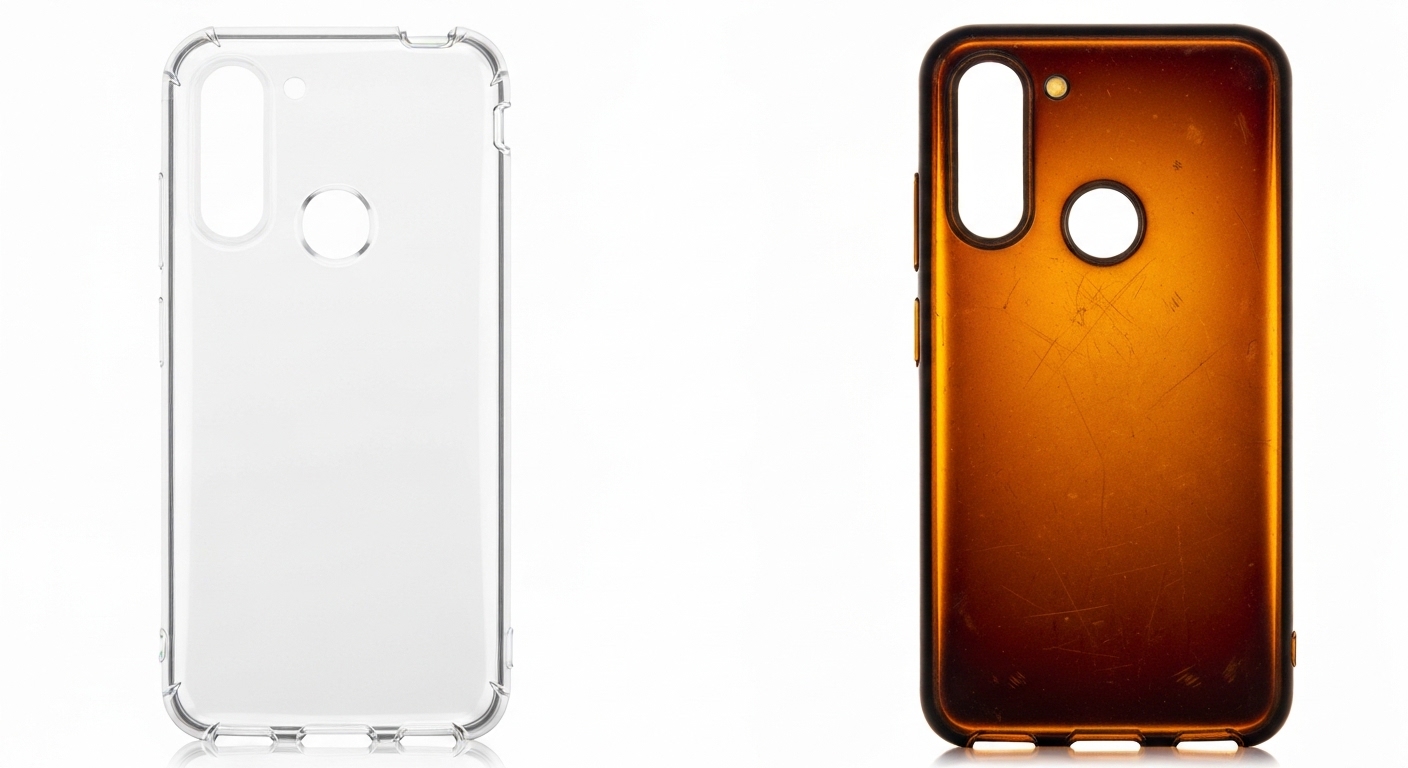
Why Clear Cases Turn “Urine Yellow”
Section titled “Why Clear Cases Turn “Urine Yellow””The universal complaint is familiar, you buy a clear case and it turns nicotine-beige.
This yellowing is chemically inevitable for many clear TPU formulations. TPU is commonly an aromatic polyurethane, which means its polymer structure contains benzene rings.
When Ultraviolet radiation from sunlight hits these aromatic groups, they undergo photo-oxidation reactions (including Photo-Fries type pathways) that generate chromophores such as quinones. Quinones absorb visible light strongly, which reads as yellow to brown.
Crucially, this is not a surface stain. The discoloration develops throughout the material, because the polymer chains themselves are chemically modified.
Heat accelerates this degradation. Your phone runs warm during charging and gaming, and that thermal energy increases oxidation kinetics, so the same case yellows faster in hot use conditions—much like the processes discussed when retrobrighting yellowed plastics like keyboard keycaps.
Phone cases are a consumable polymer system (why restoration advice often fails)
Section titled “Phone cases are a consumable polymer system (why restoration advice often fails)”General “yellowed plastic restoration” guides often assume the discoloration is either surface contamination or a reversible oxidation state change. Clear phone cases are different because you have thin sections, high UV exposure during daily carry, constant skin-oil contact, and frequent heat cycling.
Many clear cases also combine multiple polymers, coatings, magnets, and adhesives. A cleaner that is acceptable for bare plastic can still strip a hard coat, haze a glossy back, or creep under edge seams.
Best Cleaning Products for Phone Cases (TPU vs PC vs Silicone)
Section titled “Best Cleaning Products for Phone Cases (TPU vs PC vs Silicone)”Use this table as a compatibility check before you scrub. “Safer” does not mean “no risk,” it means a lower likelihood of haze, coating lift, stress cracking, or texture change when used briefly and wiped dry.
| Cleaner or method | Typical use case | TPU bumper | PC backplate (often hard-coated) | Silicone case | Notes from a polymer degradation standpoint |
|---|---|---|---|---|---|
| Mild dish soap + warm water | Routine grime removal | Safer | Safer | Safer | Lowest chemical risk, use a soft cloth and rinse fully to avoid film. |
| 70% isopropyl alcohol (IPA) wipes | Sanitizing, fingerprints | Caution | Caution | Caution | Better than 91 to 99% for coatings, wipe only, do not soak edges or seams. |
| 91 to 99% IPA | Sticker residue, heavy degrease | Risk | Risk | Caution | Higher solvent power increases coating strip risk and can embrittle some TPU finishes over time. |
| Hydrogen peroxide 3% soak | “Retrobright” attempts | Caution | Caution | Caution | May bleach some chromophores but can accelerate surface oxidation and roughness. |
| Hydrogen peroxide 12% cream (developer) + UV | Strong Retrobright attempt | High risk | Risk | High risk | Free-radical chemistry can damage surfaces, and re-yellowing is typically faster afterward. |
| Melamine sponge (Magic Eraser) | Dye transfer and scuffs | Caution | High risk | Caution | It is micro-abrasive, use only on textured TPU edges, never on glossy PC backs. |
| Baking soda paste | Odor, light grime | Caution | Caution | Caution | Abrasive particles can haze glossy surfaces, treat it like a mild sanding slurry. |
| Chlorine bleach (sodium hypochlorite) | Disinfection hack | High risk | High risk | High risk | Oxidative attack and additive damage, can weaken polymers and discolor permanently. |
| Acetone, nail polish remover | “Heavy duty” cleaning | Do not use | Do not use | Do not use | High stress-cracking risk for PC, and severe swelling or finish damage for many elastomers. |
| Glass cleaner with ammonia | Fingerprints | Risk | Risk | Risk | Surfactants and ammonia can attack some coatings and cause haze, avoid if unknown. |
| UV-C sanitizer box | Sanitizing without solvents | Safer | Safer | Safer | Avoid heat buildup, UV-C can age some polymers slowly but is generally gentler than solvent abuse. |
Cleaning protocol (phone-specific, coating-safe)
Section titled “Cleaning protocol (phone-specific, coating-safe)”Use a simple step sequence before reaching for aggressive hacks. This reduces the chance you mistake removable grime for polymer yellowing.
- Remove the case, rinse grit off under lukewarm water so you do not grind silica dust into the plastic.
- Wash with a drop of dish soap on a microfiber cloth, scrub seams and dot-matrix texture with a soft toothbrush, then rinse.
- Dry fully, especially corners and MagSafe pockets, because trapped moisture plus heat increases haze and odor.
- If sanitizing is needed, use a 70% IPA wipe with light pressure, then air-dry, and avoid repeated soaking of coated areas.
Cleaning “Jeans Stain” (Indigo Dye Transfer)
Section titled “Cleaning “Jeans Stain” (Indigo Dye Transfer)”You put your phone in new denim, and the frosted edges pick up blue. This is dye transfer.
Indigo is a fugitive dye that migrates into porous or textured elastomers, especially TPU. Soap and alcohol often fail because they do not disrupt the dye that has lodged in the near-surface.
Mr. Clean Magic Eraser (melamine sponge) can work because it is abrasive and removes the top layer holding the dye. Keep it on the soft bumper only, and keep it away from glossy PC backs or you will create permanent fogging.
Sanitizing Without Ruining the UV Coating
Section titled “Sanitizing Without Ruining the UV Coating”Phones are high-touch surfaces. The cleaning goal is microbial reduction without stripping hard coats or soft-touch finishes.
Why high alcohol concentrations can backfire: polycarbonate backs frequently have anti-scratch or UV hard coats, and TPU bumpers sometimes have soft-feel topcoats. High-strength alcohol (91% or 99%) increases the chance of coating swelling, whitening, or edge lift, particularly if it wicks into seams.
Sanitizer comparison (what I recommend in practice): soap and water is the lowest-risk daily method, because it relies on surfactants and mechanical removal. 70% IPA wipes are a reasonable compromise for disinfection, because water moderates solvent strength and contact time is typically short.
UV-C boxes avoid solvents, which is useful for coated cases and for people who sanitize frequently. They are not a cleaning tool for oils and dye transfer, and they can still contribute to long-term aging if the device runs hot or the exposure is excessive.
The “Retrobright” Bath (Peroxide): Does it Work?
Section titled “The “Retrobright” Bath (Peroxide): Does it Work?”Internet hacks suggest soaking the case in hydrogen peroxide, similar to retrobrighting old electronics.
The verdict stays the same, peroxide can work partially, but it is temporary. The chemistry is that peroxide-generated radicals can bleach some quinone chromophores back toward colorless species, which visually reduces yellowing.
The catch is mechanical. Oxidative treatment can roughen TPU surfaces, increase porosity, and accelerate future oxidation, so the case often re-yellows faster after you “fix” it.
Retrobright protocol used online: submerge the case in 12% hydrogen peroxide cream (hair developer) and expose it to strong UV light (sunlight or UV lamp) for about 24 hours. Rinse thoroughly and allow it to dry for a full day before reinstalling.
Retrobright results table (typical outcomes)
Section titled “Retrobright results table (typical outcomes)”| Attempt type | Initial color change | Surface damage risk | Typical re-yellowing timeline | Recommendation |
|---|---|---|---|---|
| 3% peroxide soak, no UV (6 to 24 h) | Minor lightening, uneven | Medium | Often 2 to 8 weeks | No, low reward for the risk |
| 12% peroxide cream + UV (24 h) | Moderate lightening, looks “cleaner” | High | Often 1 to 4 weeks | No, not for daily cases |
| Repeat Retrobright cycles | Diminishing returns | Very high | Faster each cycle | No |
Recommendation (clear yes or no): No for most users. If you do it, treat it as an experiment on a case you already plan to replace, because you are trading short-term appearance for long-term mechanical integrity.
”Blue Dye” Toners for Yellow Cases
Section titled “”Blue Dye” Toners for Yellow Cases”If you cannot bleach the yellow out permanently, you can sometimes mask it; understanding the chemistry behind restoring yellowed ABS plastic helps explain why blue neutralizes yellow visually.
Some users dye yellowed cases with Rit DyeMore (synthetic dye). Sapphire blue over yellow often produces teal, and purple over yellow often turns muddy brown.
Corrective toning with a very dilute violet bath for only seconds can desaturate the yellow cast, like a hair toner. The risk is overshooting and permanently tinting the case, because elastomers absorb dyes readily.
Why Alcohol Ruined Your “Leather” Case
Section titled “Why Alcohol Ruined Your “Leather” Case”Leather cases are dyed and finished with thin sealants. Alcohol can dissolve or haze that finish and lift dyes, and it also extracts oils that keep the leather flexible.
The result is streaking, color loss, and a dry, cardboard feel. Clean leather with a damp cloth and mild hand soap, then condition, treating it like footwear rather than a plastic accessory.
Drop Protection: Hard (PC) vs. Soft (TPU) Physics
Section titled “Drop Protection: Hard (PC) vs. Soft (TPU) Physics”Hybrid cases (hard back plus soft rim) are popular for a reason. When you drop a phone, impact energy must be dissipated or redirected.
Hard polycarbonate resists bending and protects against some abrasion, but it transmits shock more directly. Soft TPU or silicone compresses and dissipates kinetic energy as deformation and heat, functioning as a crumple zone.
The hybrid approach uses the rigid back to limit twisting while relying on the soft rim for corner impacts. From an engineering standpoint, it is an effective compromise between stiffness and energy absorption.
The “Dot Matrix” Texture Explained
Section titled “The “Dot Matrix” Texture Explained”Inside many clear cases you will see tiny dots. This is an anti-Newton-ring pattern.
Two glossy surfaces pressed together can form rainbow interference patterns and a wet-look contact patch. The dots maintain a micro air gap that prevents sticking and optical artifacts.
Dirt can lodge between these dots, so scrub the inside with a soft toothbrush during soap-and-water cleaning.
Removing Scratches from Glossy PC Cases
Section titled “Removing Scratches from Glossy PC Cases”PC scratches easily and shows swirl marks. Polycarbonate can often be polished.
Novus 2 can reduce light spiderweb scratches when applied with a microfiber cloth and gentle circular buffing. If a scratch catches your fingernail, polishing it away usually requires removing too much material, which can distort optical clarity.
MagSafe Ring Cleaning (Iron Filings)
Section titled “MagSafe Ring Cleaning (Iron Filings)”MagSafe rings attract ferrous dust. The dark ring you see can be iron filings and other metal particles.
These particles are abrasive. If trapped between the case and the phone, they can grind a permanent frosted circle into glass.
Lift filings off with sticky putty or tape, using a vertical lift rather than wiping. Wiping drags sharp particles across surfaces.
Preventive care routine (60 seconds weekly, monthly deep clean)
Section titled “Preventive care routine (60 seconds weekly, monthly deep clean)”Most “yellowing” complaints are a mix of irreversible polymer chemistry and removable contamination. A short routine slows the avoidable part, and it reduces scratch and haze buildup.
Weekly (about 60 seconds): remove the case, tap out grit, wipe the phone and case interior with a barely damp microfiber, then lift MagSafe dust with tape or putty. Finish by drying corners and buttons so moisture is not trapped against warm electronics.
Monthly (about 5 minutes): wash with dish soap and warm water, scrub dot-matrix texture and seams with a soft toothbrush, rinse thoroughly, then fully air-dry. If you need sanitizing, do one light pass with a 70% IPA wipe after drying, not before.
Real-world case tests (what typically happens)
Section titled “Real-world case tests (what typically happens)”These are representative outcomes I see repeatedly in user experiments and bench-style cleaning trials. The timeline matters because immediate “before and after” photos often hide fast reversion.
Test 1, 70% IPA wipes daily on a hybrid case: the case stays hygienic and fingerprint-free, but after 3 to 6 weeks the hard-coated PC back can develop patchy haze where the wipe pressure is highest. The TPU bumper may feel slightly tackier if it has a soft-touch coating.
Test 2, Magic Eraser on denim dye transfer: visible improvement often occurs within 2 to 5 minutes on textured TPU edges, but a matte patch can appear because you abraded the surface. On glossy PC, the same method creates permanent fogging within seconds.
Test 3, 12% peroxide cream plus sunlight for 24 hours: the case usually lightens immediately after rinsing and drying, then re-yellows over 1 to 4 weeks with a higher chance of dullness and faster future discoloration. Repeating the treatment commonly accelerates brittleness at corners.
When to Give Up (Terminal Yellowing)
Section titled “When to Give Up (Terminal Yellowing)”Once TPU has shifted to dark amber or brown, degradation is deeper than cosmetics. The polymer’s molecular weight distribution changes, elasticity drops, and the bumper can become brittle.
A brittle case cannot absorb impact effectively. If it cracks instead of deforming, more energy transfers to the phone.
A practical replacement interval for clear TPU is often 6 to 9 months, sooner for high-heat users.
Buying Guide: Which Plastics Don’t Yellow?
Section titled “Buying Guide: Which Plastics Don’t Yellow?”If you dislike yellowing, avoid clear TPU as the primary aesthetic element. You can still use TPU for impact performance, but make yellowing less visible or move the clear aesthetic to a more stable material.
Decision tree (aesthetics vs drop protection)
Section titled “Decision tree (aesthetics vs drop protection)”If you want maximum clarity for the longest time, choose a case with a glass back panel or a UV-stabilized polycarbonate back with minimal TPU exposure. If you need maximum corner drop protection, keep TPU or silicone bumpers, then choose smoke, black translucent, or patterned designs that visually hide oxidation.
If you prefer thin and rigid, a 100% polycarbonate snap case avoids most yellowing but offers less impact energy absorption. If you want soft grip and stable color, opaque silicone avoids yellowing (white can stain) and tends to look consistent longer.
FAQ: Phone Case Yellowing
Section titled “FAQ: Phone Case Yellowing”Can yellowing be reversed?
Section titled “Can yellowing be reversed?”True TPU yellowing is not fully reversible because it is a bulk chemical change in the polymer. You can remove surface oils and some dye transfer, and peroxide treatments can temporarily bleach chromophores, but the effect typically does not last.
How long do clear cases last?
Section titled “How long do clear cases last?”For clear TPU, 3 to 6 months to noticeable yellowing is common under regular sunlight and heat exposure. Many users replace at 6 to 9 months because appearance and impact performance both decline.
Does polycarbonate yellow?
Section titled “Does polycarbonate yellow?”UV-stabilized polycarbonate is relatively resistant to yellowing in phone-case use, but it scratches easily. The more common failure mode is haze or coating damage rather than uniform yellowing.
Is 70% isopropyl alcohol safe for phone cases?
Section titled “Is 70% isopropyl alcohol safe for phone cases?”It is usually safer than 91 to 99% for coated surfaces when used as a wipe, not a soak. Repeated heavy wiping can still dull hard coats over time.
Do UV sanitizer boxes damage cases?
Section titled “Do UV sanitizer boxes damage cases?”They generally avoid solvent damage and are compatible with most cases. Over long periods, UV exposure can still contribute to polymer aging, especially if heat builds up, so avoid extended cycles beyond the device’s recommendation.
Why is my MagSafe ring turning dark?
Section titled “Why is my MagSafe ring turning dark?”Magnets collect ferrous dust and fine metal particles. Remove them with tape or putty, because wiping can drag sharp particles and scratch glass or glossy coatings.
References
Section titled “References”- Journal of Applied Polymer Science, UV degradation pathways in thermoplastic polyurethane systems.
- Apple Support, official cleaning guidance for iPhone cases (silicone and leather) and cautions about solvents.
- Otterbox engineering and materials selection guidance for impact protection design.
- User-reported Retrobright trials on phone cases documented in community forums (observational outcomes and timelines).